
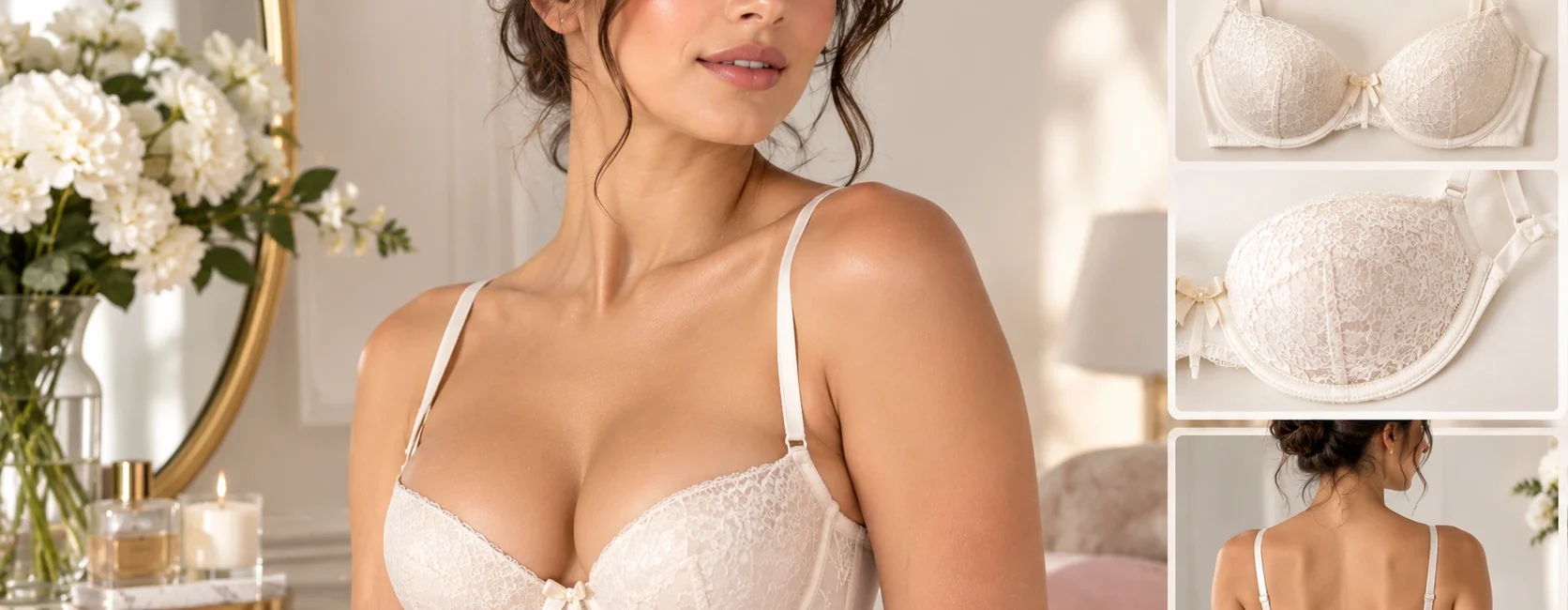
The balconette bra gets recommended constantly for square necklines, off-shoulder tops, and low-cut dresses, but most people buying one for the first time don’t actually know what separates it from a demi or a plunge, or why the same size can gape on one brand and spill on another.
What Is a Balconette Bra, Exactly?
The name comes from the Italian balcone, meaning balcony, a literal reference to the shape the cup creates. A true balconette has a sharp, horizontal cut across the top of the cup, covering roughly the lower 60 to 70 percent of the breast, paired with wide-set straps positioned toward the outer edges of the shoulders rather than close together at the center.
That horizontal top edge is the defining feature. It creates lift and shape through the cup’s structural geometry, not through padding, which is why an unlined or lightly lined balconette can still create a rounded, lifted silhouette. This is also the detail that gets misused most often in product listings: a bra with a scooped or curved cup edge marketed as a “balconette” is really a demi or T-shirt bra wearing the wrong label.
Balconette vs. Demi vs. Plunge: What Actually Separates Them
These three styles get confused constantly because they occupy similar territory: lower coverage, cleavage-forward design, but the cup construction is genuinely different in each:
| Style | Cup Top Edge | Strap Placement | Best For |
|---|---|---|---|
| Balconette | Sharp, horizontal cut | Wide-set, toward shoulder edges | Square or wide necklines, off-shoulder tops, natural lift without heavy padding |
| Demi | Curved, scooped edge | Slightly closer-set than balconette | Rounder necklines, more traditional cleavage shaping |
| Plunge | Deep V-shaped center | Angled inward toward the center | Low-cut or V-neck tops, center cleavage rather than lift |
If your goal is a rounded, uplifted shape under a wide or square neckline, a balconette is the right call. If you want center-focused cleavage under a deep V, a plunge does that job better; a balconette isn’t built to create that effect and will look and feel different than intended if worn for that purpose.
Balconette Styles: The Three Real Categories
Not every balconette inside the category is built the same way. They break down into three construction types:
- Unlined or lightly lined (1–2mm): The most traditional version, relying entirely on cup geometry rather than padding for shape. Common in lace balconettes aimed at smaller to mid-range busts.
- Padded balconette: Adds light foam or fiberfill lining for a smoother look under fitted tops, while keeping the same horizontal cut and wide-set straps.
- Full-bust balconette: Built with reinforced underwire, wider bands, and multi-part cup construction specifically engineered to support larger busts (commonly up to a K cup at specialist brands), since the horizontal cut puts more structural demand on the wire and band at bigger sizes.
Who a Balconette Bra Actually Works For
Balconette bras are frequently marketed as a small-to-mid-bust style, but that undersells the category. With the right construction, they work across a wide range of cup sizes:
- A–D cups: Generally the easiest fit, since less structural support is needed to hold the horizontal shape.
- DD–G cups: Full-bust specialist brands build reinforced balconettes specifically for this range, using firmer wire and wider bands rather than scaling down a small-bust design.
- G cup and above: A genuine but smaller category, a handful of specialist brands build balconettes rated up to K cup, engineered with the same reinforced construction used in their full-bust ranges generally.
Fixing the Two Most Common Fit Problems
Sizing issues are the single biggest reason people give up on the style entirely, and both major complaints trace back to the same root cause: incorrect size, not a flawed design.
Gapping at the top of the cup almost always means the cup is too large for your breast tissue relative to the band. Try:
- Going down a cup size while keeping the band the same, or
- Trying a “sister size” one band size down and one cup size up (for example, 34DD instead of 36D), which keeps the cup volume similar while tightening the fit
Spillage over the top or sides means the opposite: the cup is too small. Try:
- Going up a cup size while keeping the band size, or
- Sister-sizing one band size up and one cup size down (36D instead of 34DD)
Because the horizontal cut is the entire visual point of a balconette, a bra that’s even slightly the wrong size loses the shape the style is designed to create, unlike a full-coverage bra, where a slightly off size is more forgiving.
How to Choose the Right Balconette for Your Outfit
- Square or wide necklines: A classic balconette is purpose-built for this; the straight horizontal line follows the neckline shape almost exactly.
- Off-the-shoulder tops: Look specifically for convertible or wide-set strap options, since standard balconette straps can sit too far out for a true off-shoulder silhouette.
- Fitted knits or T-shirts: A padded or molded balconette avoids visible seams and nipple show-through better than an unlined lace version.
- Under sheer or delicate fabrics: An unlined lace balconette adds visible texture and detail that reads intentionally as lingerie-forward styling rather than just underwear.
Brands That Specialize in Balconette Construction
Because fit varies so much by brand-specific cup geometry, a few names consistently come up as doing balconette particularly well across different bust ranges:
- Panache, Fantasie, Freya, Elomi, and Curvy Kate: UK-based full-bust specialists known for balconette styles that extend into larger cup and band sizes without simply scaling up a small-bust pattern.
- Natori: A frequently recommended budget-friendly option for A–D cups.
- Wacoal and Goddess: Known for reinforced full-bust balconette construction with wider bands and firmer wire.
- Parade: A newer, size-inclusive brand offering balconette styles across an unusually wide size range (XS to 3XL) in a single product line.
Trying a specific style within your size range matters more than brand reputation alone, since cup geometry differs meaningfully even between two “balconette” bras from different labels.
Caring for a Balconette Bra
- Hand wash or use a lingerie bag on a cold, gentle cycle to protect the underwire and cup shape.
- Avoid the dryer entirely; heat breaks down elastic and lace far faster than air drying.
- Rotate between two or more bras rather than wearing the same one daily, giving the elastic time to recover its shape between wears.
- Store cups nested rather than folded flat, which helps the horizontal cup shape hold its structure over time.
Frequently Asked Questions
What’s the difference between a balconette and a demi bra?
A balconette has a sharp, horizontal cup edge and wide-set straps, while a demi has a curved, scooped cup edge and slightly closer-set straps. Balconette suits square or wide necklines; demi suits rounder necklines.
Are balconette bras good for large busts?
Yes, with the right construction. Full-bust specialist brands build reinforced balconette styles with wider bands and firmer underwire specifically for DD and larger cup sizes, rather than scaling down a small-bust design.
Why does my balconette bra gape at the top?
Gaping usually means the cup is too large for your breast tissue. Try a smaller cup size in the same band, or a sister size one band down and one cup up.
What necklines work best with a balconette bra?
Square necklines and off-shoulder tops are the classic match, since the straight horizontal cup edge follows those neckline shapes closely.
Is a balconette bra the same as a push-up bra?
No. A balconette creates lift and shape through cup geometry, not padding, though padded versions do exist. A push-up bra specifically uses padding or gel inserts to add volume and center cleavage, which is a different mechanism and effect entirely.



5 Comments
[…] used by far more expensive specialty brands. If you’re new to the silhouette altogether, our balconette bra shape and sizing guide breaks down how the cut works and how it differs from a demi or plunge before you shop any specific […]
[…] trying to decide between the two, it mostly comes down to your neckline and the shape you want. Our balconette bra shape and sizing guide walks through how the horizontal cut differs, which helps if you’re torn between them for […]
[…] you’re deciding between a plunge and a balconette, the deciding factor is your neckline. Our balconette bra shape and sizing guide covers the horizontal-cut style in detail, and it’s the better match for square or […]
[…] which appear across SYRN’s collections, makes a real difference in getting the fit right. Our guide to balconette bra fit and sizing is a useful primer on how cup geometry, not just band and cup number, affects whether a bra […]
[…] size, since support comes from compression and boning rather than a rigid wire channel. Our balconette bra shape and sizing guide breaks down how underwire cup geometry affects fit, which is useful context if you’re trying to […]