
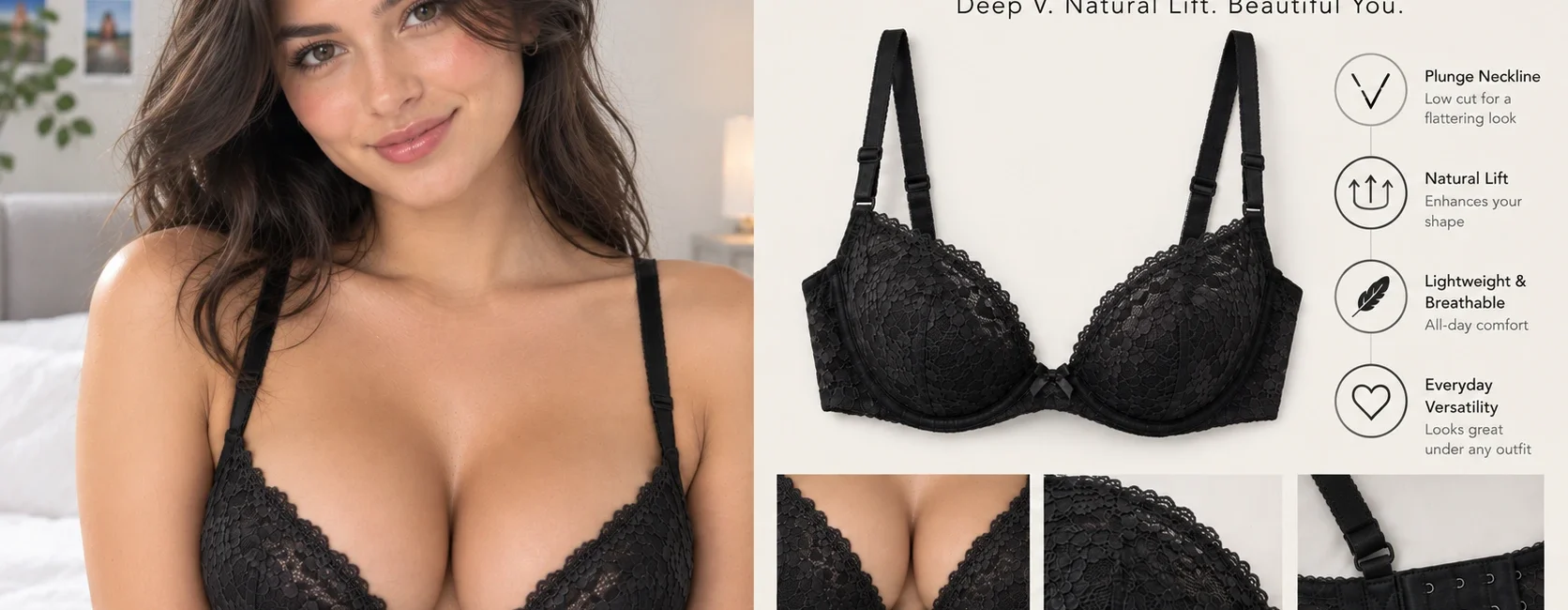
Everyone who owns a low-cut top has had the same moment: you put on a bra that’s supposed to work with your neckline, look in the mirror, and see a strap or center panel poking out exactly where it shouldn’t. A plunge bra exists to solve that one problem, but “plunge” is one of the most loosely used words in lingerie, and a bra labeled that way can still fail you if the center is too high, the cups are the wrong shape, or the size is slightly off. This guide covers what a plunge bra actually is, how deep a neckline it can realistically hide under, how it differs from similar styles, and how to fit one so it works.
What Is a Plunge Bra?
A plunge bra is defined by two construction details: a low center gore (the small panel between the cups, sitting against your breastbone) and cups that are angled inward and set wider apart, forming a deep V. Because the center sits lower than on a standard bra, it stays hidden under V-necks, wrap dresses, and low-cut tops, while the angled cups guide the bust toward the center for lift and natural cleavage.
Some brands call the same thing a “deep V” bra. The two terms are used interchangeably, one describing the overall shape and the other the cup construction. What matters is the geometry underneath: a low gore plus angled cups. A bra with a normal-height center that’s simply marketed as “plunge” won’t do the job.
Plunge vs. Push-Up vs. Balconette vs. Demi
These styles overlap in what they show and what they do, which is why they get confused. The cleanest way to separate them is to ask what each one describes:
| Style | What It Describes | Key Feature | Best Under |
|---|---|---|---|
| Plunge | Neckline shape | Low center gore, angled cups | V-necks, wrap dresses, low-cut tops |
| Push-up | Lift effect | Padding or inserts that add volume | Anything, when you want maximum lift |
| Balconette | Cup and strap shape | Horizontal cup edge, wide-set straps | Square and wide necklines |
| Demi | Coverage level | Curved, scooped cup edge | Rounder, lower necklines |
A plunge bra is about how low the center sits, while a push-up is about how much lift the cups add. The two aren’t mutually exclusive: plunge push-up hybrids exist for maximum cleavage under deep necklines, but plenty of plunge bras create a natural lifted shape without heavy padding. If you’re deciding between a plunge and a balconette, the deciding factor is your neckline. Our balconette bra shape and sizing guide covers the horizontal-cut style in detail, and it’s the better match for square or off-shoulder tops, whereas the plunge is built for neckline-plunging silhouettes that dip toward the center.
How Deep a Neckline Can a Plunge Bra Hide Under?
This is the practical question most guides skip. Brand guidance suggests that a standard plunge with a gore of roughly two inches can stay hidden under tops that dip about five to six inches below the collarbone. That covers the large majority of V-neck tops, wrap dresses, and evening wear.
Past that point, a plunge bra stops being the right tool. Tops that dip below the sternum, backless wrap dresses, and halter necks with an open front usually need a different solution: a strapless convertible bra, adhesive cups, or fashion tape, since even a good underwire plunge may show at those depths. If you’re shopping for one specific outfit, measure the neckline depth from the collarbone before you buy.
Why Plunge Bras Gap at the Center (and How to Fix It)
The most common complaint about plunge bras is center gore lift, where the panel floats away from your breastbone instead of sitting flat against it. There are usually three causes:
- Cups are too small. If tissue spills over the top or the wire sits on breast tissue instead of behind it, the gore gets pushed forward. Try a cup size up in the same band.
- The cup shape doesn’t match your shape. Plunge cups are angled and wide-set. If your breasts are fuller on the top or sit closer together, some plunge cuts won’t contain you. Try a different brand or a style with more cup depth.
- The band is too loose. A plunge relies on a snug band that sits flat against your back and does most of the support work. If the band rides up, the whole bra shifts and the center lifts.
One myth worth dropping: some guides say plunge bras only work if your breasts sit close together. A well-constructed plunge works across many shapes. What matters is a fit that contains you without gaping or spillage.
Plunge Bra Sizing and Fit Checklist
A correct plunge fit shows up in four places:
- The band: snug, level, and flat against your back, without riding up.
- The center gore: tacked flat against your breastbone.
- The cups: fully containing your breasts with no spillage at the top or sides and no gaping at the edge.
- The straps: supportive without digging, staying in place through reaching and twisting.
Size ranges have widened considerably. Some brands now offer plunge styles from AA through H, and others run 32A to 44H in their signature plunge, so the old assumption that plunge bras are only for small to medium busts no longer holds. For a fuller bust, look for construction features like three-section cups, side support panels, and firmer underwire, which specialist brands build specifically to keep a plunge stable at larger cup sizes.
Plunge Bra Styles to Know
- T-shirt plunge: Molded, smooth cups for an invisible look under fitted knits.
- Lace plunge: More decorative, often with lace overlays that help prevent gaping at the edge. Best when a bit of lace showing is fine.
- Push-up plunge: Adds padding or inserts for maximum lift and cleavage.
- Wireless or bralette plunge: Lighter and more comfortable, and a good choice for smaller busts or lounging, though less structured.
- Unlined plunge: A clean, barely-there feel with lift from cup geometry rather than padding.
How to Choose the Right Plunge Bra for Your Outfit
- V-neck tees and knits: A molded T-shirt plunge with smooth cups avoids visible seams.
- Wrap dresses: Pay attention to how the neckline sits when you move. A snug band matters more than padding here.
- Evening wear and deep necklines: Choose the deepest plunge available, or step up to a strapless convertible if the neckline drops past mid-sternum. If the neckline is square or sweetheart instead, this is where a balconette wins, and this breakdown of how the balconette cut works explains why.
- Everyday wear under office tops: A moderate plunge with light lining gives coverage that stays hidden without looking dramatic.
Caring for a Plunge Bra
- Hand wash or use a lingerie bag on a cold, gentle cycle to protect the underwire and cup shape.
- Air dry rather than using the dryer, since heat breaks down elastic and lace.
- Rotate between two or three bras so the elastic gets time to recover.
- Replace when the band stretches out. A worn plunge is the one most likely to gap, since it depends on a firm band.
Frequently Asked Questions
What is a plunge bra? A plunge bra has a low center gore and angled, wider-set cups that form a deep V, so it stays hidden under low-cut necklines while still lifting and supporting.
What’s the difference between a plunge bra and a push-up bra? A plunge describes the neckline shape, with a low center, while a push-up describes the lift effect, with padding or inserts. Some bras are both, but many plunge bras create a lifted shape without heavy padding.
Why does my plunge bra gap in the middle? Usually the cups are too small, the cup shape doesn’t match your shape, or the band is too loose. Try a larger cup, a different cup style, or a snugger band.
Can a plunge bra work for a larger bust? Yes. Look for three-section cups, side support panels, and firm underwire, and consider specialist brands that build plunge styles specifically for fuller busts.
How low can I wear a top with a plunge bra? A standard plunge typically hides under necklines that dip roughly five to six inches below the collarbone. Anything lower usually needs a strapless convertible bra or adhesive cups.


1 Comment
[…] your outfit has a deep neckline, a plunge-friendly cup is worth reading about in our guide to the plunge bra, which explains how the center gore and cup angle affect how a deep V sits on the […]