The demi bra is one of the most common styles in any lingerie drawer and one of the most misunderstood. People assume it’s only for small busts, or that it’s just a smaller version of a regular bra, or that it’s interchangeable with a balconette or plunge. None of that is quite right. A demi bra is defined by a specific cup cut, and understanding it explains why it works so well under low necklines, why it can spill if you’re sized wrong, and when a different style is the smarter choice.
What Is a Demi Bra?
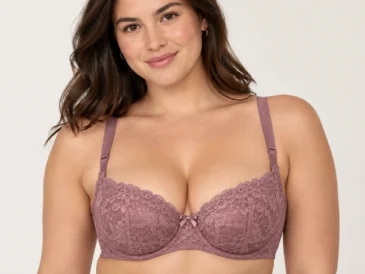
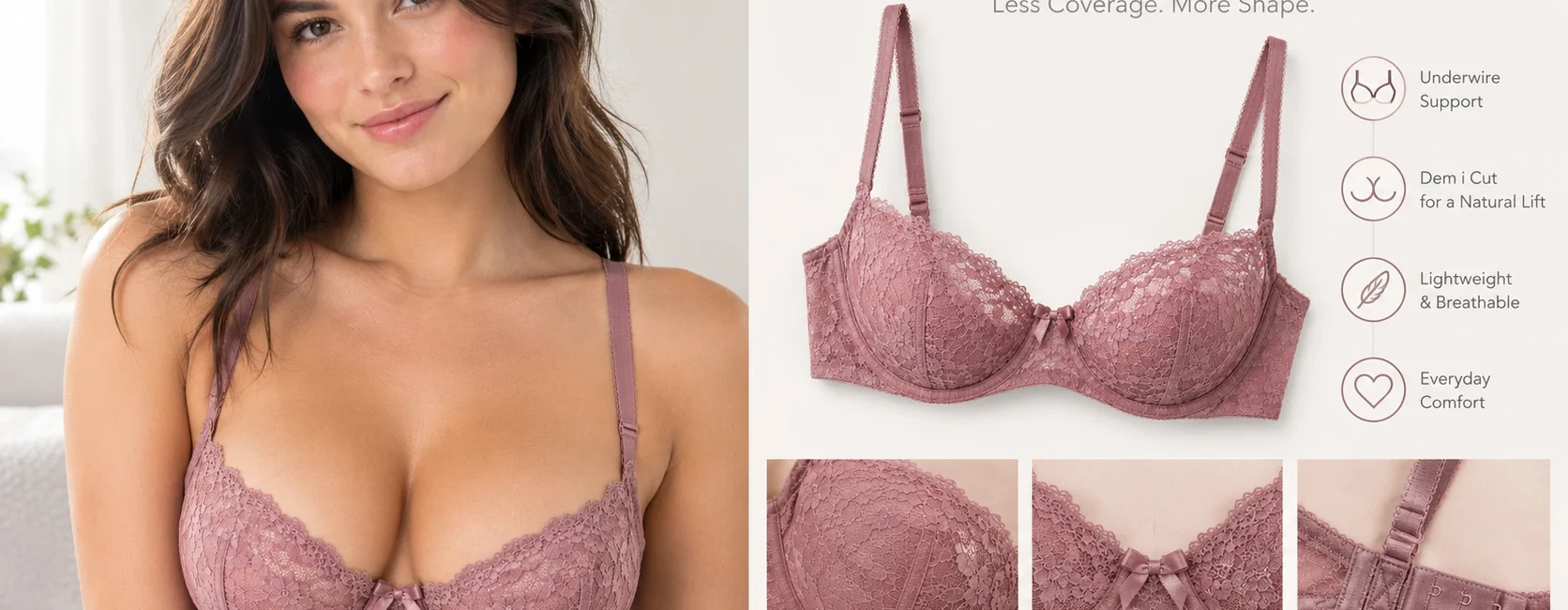
“Demi” is the French word for “half,” and that’s the whole idea: a demi bra, also called a half-cup or demi-cup bra, has cups that cover roughly half to three-quarters of the breast. The top of the cup is cut low with a gentle curve, and the straps are usually set wider toward the shoulders, which leaves more skin exposed at the top of the bust and lets the bra stay hidden under lower and wider necklines.
One point that trips people up: “demi” describes the style and cut of the cup, not a size. There’s no such thing as a “demi size” in the way there’s a 34C. A demi bra comes in the same band and cup sizes as any other bra, and the low cut works with whatever size you actually wear.
How Much Does a Demi Bra Actually Cover?
A helpful rule of thumb from lingerie fit guides: a well-fitting demi cup should reach about one inch above the nipple point. That gives it enough coverage to contain you securely while keeping the top edge low enough to disappear under a scooped or V-neckline.
Compared with a full-coverage bra, which encloses the entire breast with a higher neckline and straps set closer to the neck, a demi trades some containment for versatility. It won’t offer the same total support as a full cup, but it’s a strong everyday option for anyone comfortable with less coverage.
Demi vs. Full Coverage vs. Balconette vs. Plunge
Four styles cover most of the ground between “full coverage” and “very low-cut,” and they get mixed up constantly:
| Style | Cup Coverage | Top Edge | Strap Placement | Best Under |
|---|---|---|---|---|
| Full coverage | Entire breast | High, encloses fully | Closer to the neck | High necklines, maximum support |
| Demi | About half to three-quarters | Low, gently curved | Wider-set | Scooped and wide necklines |
| Balconette | Similar to demi | Straight, horizontal cut | Wide-set at the shoulder edges | Square, sweetheart, and off-shoulder |
| Plunge | Varies, deep center | Low center with angled cups | Angled inward | V-necks and deep plunging tops |
The difference between demi and balconette is the shape of the top edge: a demi has a curved, scooped edge, while a balconette has a straight, horizontal one that creates a “balcony” look and a wider, rounder shape. If you’re trying to decide between the two, it mostly comes down to your neckline and the shape you want. Our balconette bra shape and sizing guide walks through how the horizontal cut differs, which helps if you’re torn between them for square tops.
The plunge is lower still at the center. A demi shows a bit less than a full-coverage bra all around, while a plunge specifically drops the center gore for deep V necklines.
Who Should Wear a Demi Bra?
The conventional advice is that demi bras suit small to medium busts, and that people with fuller or heavier busts should choose full coverage or balconette styles instead. There’s a reason for that: a demi has less cup area doing the work, so the support comes largely from the band and underwire rather than from full enclosure, and that’s harder to achieve at larger sizes.
But it isn’t a hard rule. A demi is a construction choice, and a well-built one with a firm band, quality underwire, and enough cup depth can work across a wider range of sizes than the stereotype suggests. The better question isn’t “am I small enough?” but “does this particular bra contain me without spilling or gaping?” If you have a fuller bust and love the look of a demi, look for styles with reinforced side support and deeper cups, and try a few before deciding.
Types of Demi Bras
Demi bras come in far more varieties than the plain basic:
- Classic demi: The everyday version, offering natural lift and a rounded shape without added padding.
- Push-up demi: Combines the low cut with padding or shaping at the base of the cup for extra lift and cleavage.
- T-shirt demi: Smooth, molded cups that stay invisible under fitted knits.
- Lace demi: More decorative, often with a lingerie-forward look.
- Strapless demi: Removable or absent straps for off-shoulder and strapless outfits.
- Wireless demi: More comfort and a softer shape, with less structure.
- Demi balconette and demi plunge hybrids: Blends that borrow the strap placement or center depth of the other styles.
What to Wear With a Demi Bra
A demi works best under necklines that are lower or wider than a standard crew:
- Scoop necks and wide necklines: The natural home for a demi. The low cup edge stays hidden.
- Low-cut tops and dresses: A full-coverage bra tends to peek above the edge, while a demi slips undetected.
- Off-shoulder and wide-strap styles: Wide-set straps sit clear of the neckline, which matters here.
- Everyday tops generally: Because it’s less bulky, a demi also works under higher necklines with ease, so it isn’t limited to low-cut outfits.
The one neckline a demi isn’t ideal for is a deep plunge. If your top dips well toward the center, a plunge bra with a lower gore is usually the better match. Always try the bra on under the actual top when you can, since neckline shapes vary a lot.
Fit Checklist: Avoiding Spill and Gap
Because a demi covers less, sizing matters more. A few checks:
- Band first. The band should sit level, snug, and flat against your back. It does most of the support work in a demi.
- Cups contain without spilling. If tissue bulges over the top or sides, go up a cup size in the same band.
- No gaping at the top edge. If the cup edge lifts away from your breast, the cup is too big. Try a smaller cup or a sister size, one band down and one cup up.
- Wires sit behind the breast tissue, not on top of it, and lie flat against your ribcage.
- Straps hold without digging. Because they’re wider-set, they should stay in place through reaching and twisting.
Caring for a Demi Bra
- Hand wash or use a lingerie bag on a cold, gentle cycle.
- Air dry, since heat wears down elastic and lace.
- Rotate between bras so the band can recover its shape.
- Replace when the band stretches. Since the band does most of the work in a demi, a worn-out one is the first thing to fail.
Frequently Asked Questions
What does “demi” mean in a bra?
It comes from the French word for “half.” A demi bra has cups that cover roughly half to three-quarters of the breast, with a lower neckline than a full-coverage bra.
Is a demi bra the same as a balconette?
No. A demi has a curved, scooped cup edge, while a balconette has a straight, horizontal cut and wide-set straps. They overlap in coverage but look and fit differently.
Can you wear a demi bra with a large bust?
It’s possible, but many fit guides suggest full-coverage or balconette styles for heavier busts because a demi offers less cup enclosure. Look for reinforced side support and deeper cups, and prioritize a snug band.
How much coverage does a demi bra give?
Typically about half to three-quarters of the breast. A good fit puts the cup edge about an inch above the nipple.
What tops go best with a demi bra?
Scoop necks, wide necklines, low-cut tops, and off-shoulder styles are the best matches, since the low cup edge stays hidden underneath.