Across ten widely discussed skincare ingredients, US search interest tracks the volume of randomized trials and systematic reviews closely (rank correlation 0.81). Azelaic acid breaks the pattern. It took 10% of combined searches in the past year, against 2.6% of the randomized-trial and review papers. Hyaluronic acid breaks it in another way: it received 49% of the news and blog mentions in our sample, against 16% of searches.
What we measured
We compared ten ingredients: retinol and related retinoids, niacinamide, vitamin C, hyaluronic acid, salicylic acid, azelaic acid, peptides, snail mucin, bakuchiol and centella. For each we pulled three signals: weekly US search interest from October 2021 to September 2026, 10,652 mentions in news and blog articles (June 2025 to May 2026), and 2,992 research papers from 2017 to 2025 sorted by study design. We then compared which themes in that news coverage rose and fell between two 12-month windows.
A note on “evidence”. A paper labeled a randomized trial is a trial design, not a result. Counting designs tells us where the strongest kind of testing exists. It does not tell us that an ingredient works. Everything below should be read as “evidence suggests” or “does not show”.
Finding 1: searches line up with trial evidence
Retinol leads on both. It holds 28.5% of combined search interest and 39.0% of the randomized-trial and systematic-review papers (79 trials and 27 reviews, 106 in total). Hyaluronic acid, salicylic acid and vitamin C sit close to the equal-share line.
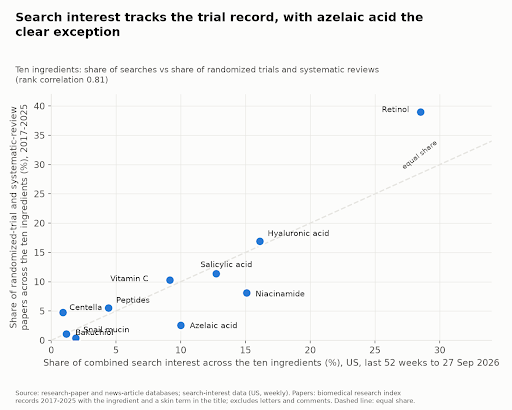
The wider picture is thin, though. Across all ten ingredients we found 272 randomized-trial and review papers, 9% of the 2,992 papers. Laboratory and animal studies made up 838 papers, 28%. That is about three lab papers for every trial or review.
Finding 2: the design mix separates old ingredients from new ones
Retinol papers are mostly human studies: trials, reviews, other clinical work. Salicylic acid has the highest controlled-study share, 24.8%. Newer names are different. Of 72 snail mucin papers, 38 (53%) were laboratory or animal work, and we found one randomized trial. Of 821 centella papers, 363 (44%) were laboratory or animal work, against 13 trials and reviews (1.6%). Bakuchiol has 102 papers, 40 of them laboratory or animal work, and three trials or reviews.
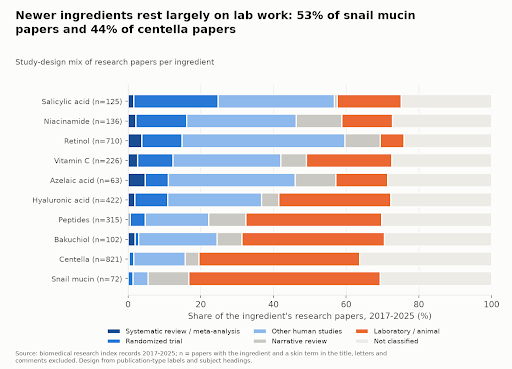
This does not mean the newer ingredients fail. It means the strongest kind of human testing is scarce in this window. A 2022 systematic review of bakuchiol and a split-face study of a snail-secretion product used after laser treatment exist (Puyana, Chandan and Tsoukas, 2022; Truchuelo and Vitale, 2020), but one trial or a handful of reviews cannot settle a question.
Finding 3: news coverage is the outlier
News and blog mentions are the loosest of the three signals. Hyaluronic acid drew 5,254 of the 10,652 mentions (49.3%). Its share of searches was 16.1% and its share of trials and reviews 16.9%. Our count is of mentions, so retail pages, injectable treatments and supplements can add to it. Even so, the gap is wide.
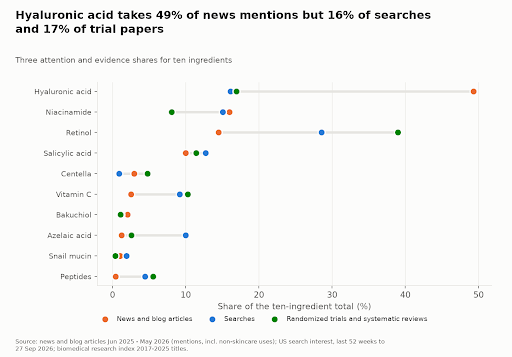
Niacinamide shows a milder version. It took 15.1% of searches and 16.0% of mentions, but 8.1% of trials and reviews (19 trials, 3 reviews). Centella goes the other way: 4.8% of trials and reviews, 0.9% of searches.
What the news is talking about: rising and falling themes
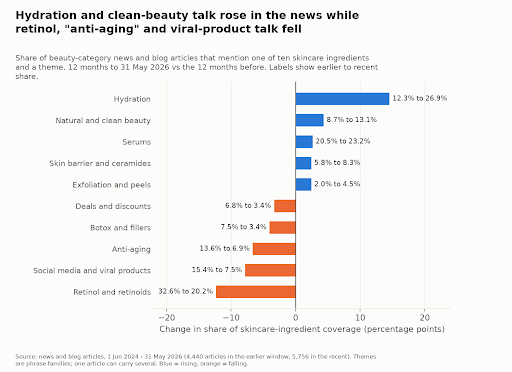
Totals hide what coverage is about, so we compared themes across two equal windows: the 12 months to 31 May 2026 and the 12 months to 31 May 2025. News ingest thins after May 2026, so the recent window stops there. The pool is news and blog articles filed under beauty or skincare categories that mention any of the ten ingredients: 4,440 articles in the earlier window and 5,756 in the recent one, 30% more. A theme is a family of phrases found in an article’s opening text or tags, listed in the table below, and one article can carry several themes. The figures are each theme’s share of the pool.
| Theme | Phrases matched (opening text or tags) | Share, 12 months to May 2025 | Share, 12 months to May 2026 | Change (points) |
| Hydration | hydrat | 12.3% | 26.9% | +14.6 |
| Natural and clean beauty | clean beauty, natural, organic, vegan, plant-based | 8.7% | 13.1% | +4.4 |
| Serums | serum | 20.5% | 23.2% | +2.7 |
| Skin barrier and ceramides | skin barrier, barrier repair, ceramide | 5.8% | 8.3% | +2.5 |
| Exfoliation and peels | exfoliat, peel, chemical exfoliant | 2.0% | 4.5% | +2.5 |
| Retinol and retinoids | retinol, retinoid, tretinoin | 32.6% | 20.2% | -12.4 |
| Social media and viral products | tiktok, viral, instagram | 15.4% | 7.5% | -7.9 |
| Anti-aging | anti-aging, anti-ageing, antiaging | 13.6% | 6.9% | -6.7 |
| Botox and fillers | botox, filler, injectable | 7.5% | 3.4% | -4.1 |
| Deals and discounts | deal, discount, sale, coupon, black friday, prime day | 6.8% | 3.4% | -3.4 |
Table 2. Five rising and five falling themes, with the phrases that define each.
Five themes rose. Hydration moved from 12.3% to 26.9% of the pool, the largest swing in either direction, and coverage of natural and clean beauty, serums, skin barrier care and exfoliation also gained share. Five fell. Retinol and retinoids dropped from 32.6% to 20.2%; anti-aging language halved, from 13.6% to 6.9%; and talk of viral products, Botox and fillers, and deals fell with it.
The retinol result matters most. Retinol articles fell in number as well as share, from 1,447 to 1,165 inside the pool, and mentions of retinol itself fell from 1,876 to 1,543 across all news categories, while US searches for retinol stayed the highest of the ten. The public still looks for the ingredient with the longest trial record, but the news has moved on to hydration and barrier care.
Treat this as a rough reading. The match is by phrase, and loose words such as “natural” and “deal” pick up some unrelated text. A second method used the pipeline’s curated subcategory labels. It agreed that Botox and dermal-filler coverage fell (2.2% to 0.4% of labelled articles) but disagreed on which themes were rising, because the share of articles carrying a label rose from 46% to 60% between windows. We therefore rely on the phrase method. The whole category also grew in early 2026: in the four months to May 2026, each of the eight biggest rising skincare themes had 1.4 to 1.7 times the articles of the four months before, so raw growth would flatter every theme and shares are the fairer test.
Finding 4: a category-wide spike hides what is really rising
US search interest for every ingredient jumped together from late March to June 2026. Retinol reached its highest week in our five-year series in the week of 12 April 2026. We found no ingredient-specific cause and do not attribute one.
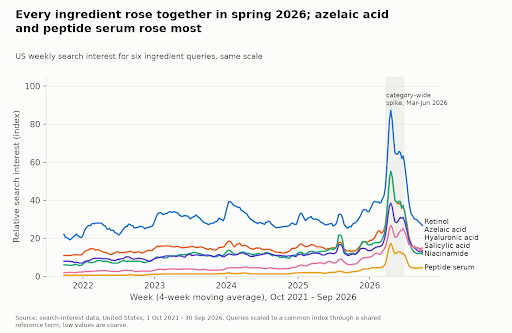
Because the spike lifted everything, the 12-month change is misleading: retinol was up 54%, niacinamide 77% and hyaluronic acid 65%. The cleaner test is the most recent quarter, July to September 2026, against the same weeks a year earlier. Retinol was up 8%, hyaluronic acid 5% and salicylic acid 13%. Niacinamide was down 13%. Two queries stayed far above last year: azelaic acid (up 109%) and peptide serum (up 98%).
Both rose from different starting points. Azelaic acid has an index of 15.4 against retinol’s 43.9. Peptide serum sits at 6.8. Snail mucin went the other way, down 33% in the same quarter.
Finding 5: where azelaic acid is gaining
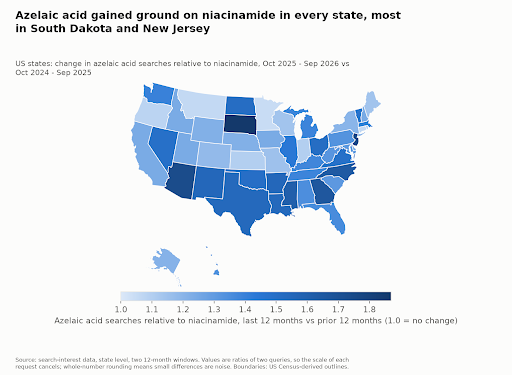
Azelaic acid is the ingredient where demand has moved ahead of the trial record in our window. It has 63 papers since 2017, with four randomized trials and three systematic reviews. Our window starts in 2017, so older trials are not counted, and a 2016 randomized trial of an azelaic acid foam for rosacea reported superiority over its vehicle (Solomon et al., 2016). The point is the gap between rising demand and recent testing, not an absence of evidence.
We also looked at where it is rising. We compared azelaic acid to niacinamide in each state, last 12 months against the 12 before. Azelaic acid gained ground in each of the 50 states and the District of Columbia. The median state ratio was 1.34. South Dakota (1.87), New Jersey (1.76), Arizona (1.74), Georgia (1.66) and North Carolina (1.64) rose most. Minnesota (1.05) rose least.
| Ingredient | Search index, last 52 weeks | Searches, Jul-Sep 2026 vs 2025 | News and blog mentions | Trials and reviews (papers) | Lab or animal share of papers |
| Retinol / retinoids | 43.9 | +8% | 1,543 | 106 | 6% |
| Hyaluronic acid | 24.8 | +5% | 5,254 | 46 | 31% |
| Niacinamide | 23.2 | -13% | 1,701 | 22 | 14% |
| Salicylic acid | 19.6 | +13% | 1,065 | 31 | 18% |
| Azelaic acid | 15.4 | +109% | 132 | 7 | 14% |
| Vitamin C | 14.1 | +17% | 271 | 28 | 24% |
| Peptides | 6.8 | +98% | 43 | 15 | 38% |
| Snail mucin | 2.9 | -33% | 110 | 1 | 53% |
| Bakuchiol | 1.8 | +0% | 220 | 3 | 39% |
| Centella | 1.4 | +0% | 313 | 13 | 44% |
Table 1. Ten ingredients across three signals. Search index is relative (retinol’s highest week = 100). Papers are 2017-2025; trials and reviews = randomized trials plus systematic reviews and meta-analyses.
What Skincare Ingredients deserves attention in 2027
We do not forecast, and nothing here is medical advice. Reading the three signals together, four things stand out.
- Retinol and salicylic acid: demand and testing are both large. A 2025 network meta-analysis reported that retinol and tretinoin improved fine wrinkles (Lin et al., 2025).
- Azelaic acid and peptides: demand is rising faster than the trial base. For peptides, 118 of 315 papers (37.5%) were laboratory or animal work.
- Hyaluronic acid: news volume is out of step with both searches and trials. The US Food and Drug Administration has no authority to require premarket approval of cosmetics or their ingredients, except color additives (Wells, 2023), so product claims are worth reading alongside the study design behind them.
- Snail mucin, centella and bakuchiol: small search volume and thin human testing.
Method and limits
Searches. US weekly search-interest data, 1 October 2021 to 30 September 2026. Values are relative, not absolute counts. Queries were scaled to a common index through a shared reference term, and low values (snail mucin, bakuchiol, centella) are coarse. We could not source absolute monthly search volumes, so none are reported. “Peptide serum” was the search query; the paper count covers peptides in topical or cosmetic contexts, so the two are close but not identical.
News and blog articles. Mentions of the ingredient name, 1 June 2025 to 31 May 2026. The vitamin C query was “vitamin C serum” and centella was “centella asiatica”. News ingest thins after May 2026, so we stopped there. Mentions measure attention, not importance, and include retail pages.
News themes. Beauty-category news and blog articles (categories skincare, beauty, beauty and personal care, cosmetics, personal care, health and beauty) mentioning any of the ten ingredient terms, counted once each. Windows: 1 June 2024 to 31 May 2025 and 1 June 2025 to 31 May 2026. Themes are phrase families chosen from the coverage and listed in Table 2; they are not exclusive and were scored in the same way in both windows.
Research papers. Biomedical papers from 2017 to 2025 with the ingredient name and a skin term in the title (stricter terms for peptides, and filler or joint-related titles excluded for hyaluronic acid). Letters, comments and editorials were excluded. Design comes from publication-type labels and subject headings. Titles only means some relevant papers are missed, and the same rule applies to every ingredient. Retinol includes the retinoid family, and niacinamide includes nicotinamide. Counts of papers about an ingredient are not counts of papers showing it works.
Data and analysis. The news, search and research-paper analysis in this article was run with Fliar Prism (Fliar Business Intelligence, 2026a), and the research tools it uses are published as the open-source Prism MCP (Fliar Business Intelligence, 2026b).
Other limits. Ten ingredients is a small sample, so the rank correlation is indicative. Rounded search values make small differences unreliable. We did not use community discussion data.
References
Fliar Business Intelligence (2026a) Fliar Prism: news, search and research-paper analysis [Data and analysis platform]. Available at: https://fliarbi.com/prism/ (Accessed: 27 October 2026).
Fliar Business Intelligence (2026b) Prism MCP: open-source research tools [Software]. GitHub. Available at: https://github.com/fliarbi/prism-mcp (Accessed: 27 October 2026).
Lin, L. et al. (2025) ‘Comparative efficacy of topical interventions for facial photoaging: a network meta-analysis’, Scientific Reports, 15, article 26889. Available at: https://doi.org/10.1038/s41598-025-12597-0.
Puyana, C., Chandan, N. and Tsoukas, M. (2022) ‘Applications of bakuchiol in dermatology: systematic review of the literature’, Journal of Cosmetic Dermatology, 21(12), pp. 6636-6643. Available at: https://doi.org/10.1111/jocd.15420.
Solomon, J.A., Tyring, S., Staedtler, G., Sand, M., Nkulikiyinka, R. and Shakery, K. (2016) ‘Investigator-reported efficacy of azelaic acid foam 15% in patients with papulopustular rosacea: secondary efficacy outcomes from a randomized, controlled, double-blind, phase 3 trial’, Cutis, 98(3), pp. 187-194. Available at: https://www.mdedge.com/cutis/article/111439/rosacea/investigator-reported-efficacy-azelaic-acid-foam-15-patients.
Truchuelo, M.T. and Vitale, M. (2020) ‘A cosmetic treatment based on the secretion of Cryptomphalus aspersa 40% improves the clinical results after the use of nonablative fractional laser in skin aging’, Journal of Cosmetic Dermatology, 19(3), pp. 622-628. Available at: https://doi.org/10.1111/jocd.13052.
Wells, N. (2023) FDA regulation of cosmetics and personal care products under the Modernization of Cosmetics Regulation Act of 2022 (MoCRA). CRS Report R47826. Washington, DC: Congressional Research Service. Available at: https://www.congress.gov/crs_external_products/R/PDF/R47826/R47826.3.pdf.