Everyone agrees that four perfumes is a smart number. Far fewer guides explain how four bottles can actually cover a humid August, a dry-heated February and every shoulder season in between. Most simply hand you one scent per season and call it done. That works on paper, but it breaks the moment spring turns out to be 90 degrees, or your office is freezing in July.
Why “One Scent Per Season” Is the Wrong Four
A common minimalist formula is to start with four fragrances, one for each season, then expand to about eight once you know which seasons you wear most. It’s a perfectly reasonable starting point. But it has three weak spots:
- Seasons aren’t scents. A “fall” fragrance might be perfect in Minneapolis and miserable in Miami.
- Indoors changes everything. Central heating and air conditioning can make the same perfume feel completely different from one hour to the next.
- You end up with gaps. The “spring” bottle sits idle for nine months of the year in some climates.
A better minimalist wardrobe gives each bottle a role, so every one is useful for several months and for several kinds of days. If you want the big-picture version of this idea, including occasions, storage and a broader look at scent families, our guide to building a fragrance wardrobe is a good companion. This article is the tightly edited version: four bottles, no spare.
Meet the Four: One Shelf, Four Jobs
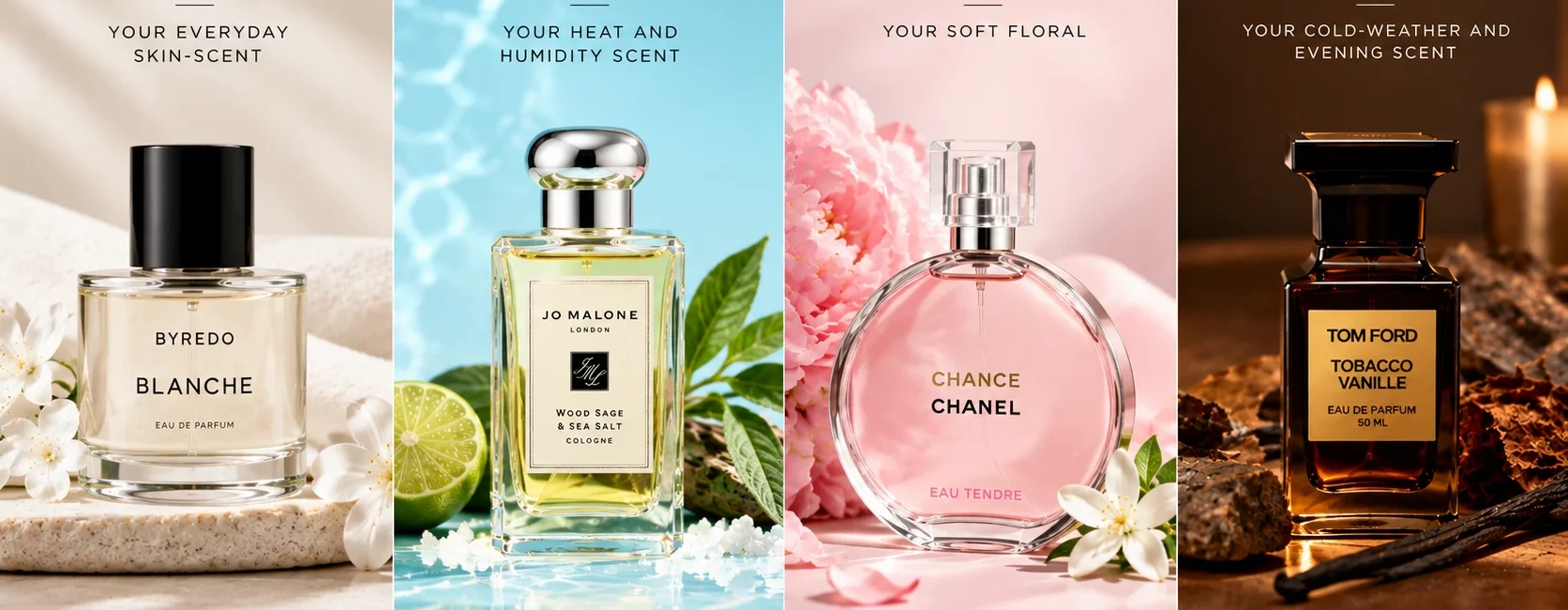
1. The Anchor: your everyday skin-scent
Scent family: musky, soft woods, mineral or airy woods. Job: the one you reach for when you don’t want to think.
Soft woods and musks stay quiet in the heat and don’t get cloying in the cold, which is why this role works nearly year-round. It’s the bottle for the office, errands, flights and days you’d rather smell like “clean and put together” than like a perfume. Fragrance roundups often place airy, mineral woody scents in the all-season category. Jo Malone’s Wood Sage & Sea Salt is one example worth sampling.
2. The Bright One: your heat and humidity scent
Scent family: citrus, bergamot, aquatic, green. Job: keep you fresh when the weather is working against you.
Citrus and aquatic notes sit at the top of a fragrance and fade first, so this role is built for hot, humid days and for anyone who doesn’t want a heavy scent hanging in the air. Classic examples worth sniffing include CK One, Acqua di Giò and Light Blue.
3. The Heart: your soft floral
Scent family: light to medium florals, with a touch of fruit or green. Job: the bridge between seasons and the “dressed up but not trying hard” choice.
A soft floral covers spring, early summer, brunches, dates and any day you want something a little more expressive than the Anchor. Daisy, Miss Dior and Chance Eau Tendre are popular examples in this lane.
4. The Warm One: your cold-weather and evening scent
Scent family: amber, vanilla, resin, warm spice, richer woods. Job: make evenings and cold days feel intentional.
Cold air slows evaporation, so dense, warm compositions have room to develop. Terre d’Hermès, Coco Mademoiselle and Baccarat Rouge 540 are often named in this space.
A note on examples: these are well-known starting points for sampling, not rules. Formulas and prices change, and scent is personal, so test on your skin before buying a full bottle.
The Weather Rewrites the Rules
Here’s the part most “four scents” lists skip. The same bottle behaves differently depending on temperature, humidity and how dry your skin is. According to fragrance retailer guides:
- Heat speeds evaporation. A scent can be strong at first but fade within a few hours (one guide estimates roughly two to four), and light top notes disappear first. Spray clothing as well as skin, use cooler spots such as the inner wrists, and plan to reapply.
- Cold slows evaporation, so scent often lasts most of the day but stays closer to the body. Moisturize first, use pulse points and be a little more generous.
- High humidity can make scent travel farther and feel more vivid, while sweat dilutes it. Lighter, fresher scents and fewer sprays usually work better.
- Dry air makes fragrance fade faster because dry skin holds scent oils poorly. Moisturize before spraying and consider adding a spray or two.
This is why a calendar-based wardrobe can fail. Your climate decides which of the four does the heavy lifting.
The Season Switchboard
Use this table as your default, then adjust for your own weather.
| When | Lead scent | Backup | Adjustment |
|---|---|---|---|
| Spring | The Heart | The Anchor | Light application, spray after a shower |
| Summer | The Bright One | The Anchor | Spray clothing, reapply every few hours |
| Early fall | The Anchor | The Heart or Warm One | Start layering warmth in the evening |
| Late fall | The Warm One | The Anchor | One spray fewer indoors |
| Winter | The Warm One | The Anchor | Moisturize first, pulse points, slightly more sprays |
| Hot spell in cold season | The Bright One | The Anchor | Skip the Warm One until it cools |
| Cold snap in summer (or heavy AC) | The Anchor | The Heart | Lighter touch, since cool rooms hold scent longer |
Notice that the Anchor shows up in every row. That’s the point: one dependable bottle covers the unpredictable days.
The Quiet Lever: Concentration
You can stretch four bottles further by choosing the right strength. Fragrance guides typically describe:
| Type | Typical oil content | Best for |
|---|---|---|
| Eau Fraîche | Around 1 to 3% | Very hot days, light refresh |
| Eau de Toilette (EDT) | Around 5 to 15% | Warm weather, daytime |
| Eau de Parfum (EDP) | Around 15 to 20% | Cooler weather, evenings, longer wear |
| Parfum | 20% and up | Cold weather, special evenings |
Guides disagree a little on shoulder seasons, since EDP can suit both spring and fall. Percentages vary by brand, so treat them as a rough guide. A practical rule: if you own a favorite in both EDT and EDP, wear the EDT in heat and the EDP in the cold, and you’ve effectively expanded your wardrobe without adding another scent.
The Two-Minute Morning Decision
Dress, then scent, in this order:
- Check where your day happens. Mostly outdoors, mostly indoors, or both?
- Check the temperature and humidity, not just the date.
- Pick the role, not the bottle. Do you need quiet (Anchor), fresh (Bright), expressive (Heart) or warm (Warm One)?
- Spray once, then wait. A scent that is invisible to you often reads clearly to everyone else.
This borrows the logic of a weather-proof outfit. In our look at a rain-to-cold commute wardrobe, the idea is to plan for each stage of your day instead of just the temperature at the door. Scent works the same way: a perfume that feels subtle on a cold platform can feel strong in a warm train car, so choose for the longest stretch of your day.
Matching the Four to Your Week
A minimalist wardrobe only works if each bottle earns its place. Here’s how the four typically map to real life:
- Office or school: the Anchor, with a light hand
- Weekend, brunch or travel: the Bright One or the Heart
- Date night or dinner: the Heart or the Warm One
- Formal events and cold evenings: the Warm One
Your outfit often hints at the right choice. A crisp linen look suits the Bright One, while a tailored coat and evening shoes call for the Warm One. If you’re stuck on what to wear for different occasions in the first place, our outfit ideas for every occasion can help you pick the look, and the scent will follow. Even that guide notes that a subtle scent is a small detail that makes a date-night outfit feel finished.
Make Four Bottles Feel Like Eight (Without Buying Four More)
Minimalism doesn’t mean one-note. You can stretch your shelf with a few simple moves:
- Layer in the right order. Shower, moisturize on slightly damp skin, then spray. Fragrance clings better to hydrated skin.
- Use a matching body mist for refreshes. Light mists are good for reapplying and for changing the mood, though they usually don’t last as long as perfume. In our EOS body mist review, a mist lasted roughly three to five hours on skin, longer when layered over a matching lotion, and hair and clothing held the scent longer.
- Switch application, not the scent. One spray on clothing gives a softer, more diffuse result than the same spray on skin.
- Pair a quiet Anchor with one bold accent. A dab of the Warm One over the Anchor on a winter night creates a new scent without a new bottle. Test combinations at home first, and stop using anything that irritates your skin.
Build the Four Without Wasting Money
The biggest minimalist mistake is buying full bottles blind. A smarter approach:
- Sample first. Samples, travel sizes and discovery sets let you test a scent over several hours and several days.
- Wear it five times before you commit. A great first impression can turn into a headache by day three.
- Fill one role at a time. Start with the Anchor, since it gets the most wear.
- Consider decants for the occasional scent. Decants and testers are a lower-cost way to try niche or expensive perfumes. If you’re curious about where people buy them, this look at Fragrance Nevaeh explains how that retailer’s pricing works and how to verify authenticity, which matters with any discounted fragrance.
- Buy the full bottle only for what you reach for.
What to Skip
- Scents that fit two roles badly. If two of your bottles smell similar, one of them isn’t earning its place.
- Heavy fragrances in a heat wave. They can turn cloying fast.
- Gifted bottles you don’t love. Four is a rule, not a quota.
- Over-spraying. Scent fatigue makes you smell less of your own perfume, which tempts you to add more.
- Poor storage. Heat, light and humidity break perfume down, so keep bottles tightly closed in a cool, dark place, not on a sunny bathroom shelf. Our fragrance wardrobe guide covers how to store your perfumes in more detail.
Quick Answers
How many perfumes do I need for a minimalist fragrance wardrobe?
Four is a solid start: one quiet everyday scent, one fresh, one floral and one warm.
Can four scents really cover every season?
Yes, if you choose by weather and role instead of by calendar, and adjust strength and application.
What’s the best all-season scent?
Soft woods, musks and airy, mineral compositions are the most flexible. Sample before buying.
Should I wear stronger perfume in winter?
Often yes. Cold air slows evaporation, so richer scents and higher concentrations tend to work well, while heat favors lighter formulas.
Does perfume last longer in summer or winter?
Generally longer in the cold, though it projects less. In heat it can feel strong at first, then fade within a few hours.
How do I make perfume last longer?
Moisturize first, spray pulse points and clothing, and consider layering with a matching lotion or mist.
Should the scent be gendered?
No. Choose what you love. Scent families are not tied to gender.
Your Four-Bottle Shelf at a Glance
| Role | Family | Best months | Backup tip |
|---|---|---|---|
| Anchor | Musk, soft or mineral woods | Year-round | Your default on unpredictable days |
| Bright One | Citrus, aquatic, green | Summer, humid days | Spray clothing and reapply |
| Heart | Soft florals | Spring, early summer | Light application |
| Warm One | Amber, vanilla, spice, rich woods | Late fall, winter, evenings | Moisturize first and use pulse points |
Start with the Anchor, add the others as you discover what you love, and let the weather decide the rest. That’s the whole system: four bottles, four roles, and a scent that suits the day instead of the date.