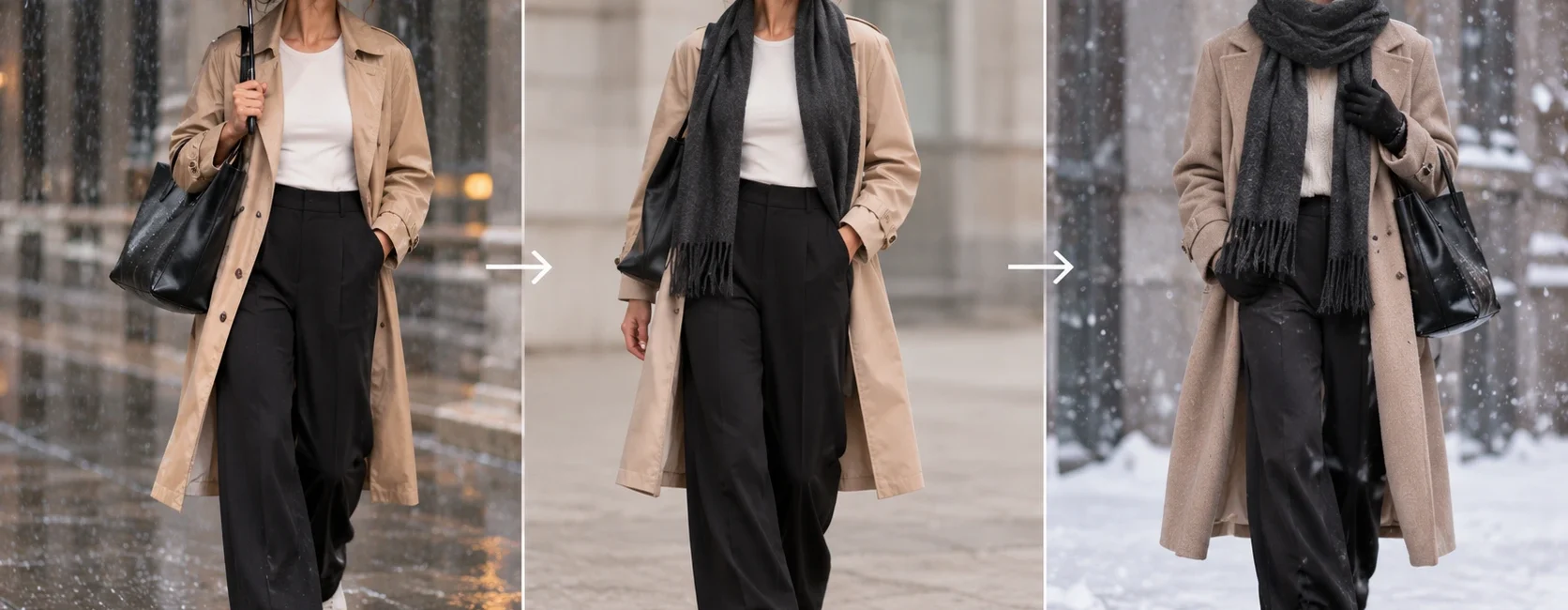
An autumn or winter commute rarely stays at one temperature. A walk to the station can be wet and windy, the train can feel overheated, and the last stretch to work may be colder than the first. Choosing an outfit for only the forecast high or only the first few minutes outside is why many otherwise stylish looks become uncomfortable by lunchtime. A better approach is to plan for transitions: where you wait, where you move, and where you can adjust a layer without rebuilding the entire outfit.
Map the route before choosing the coat
Divide the trip into three ordinary moments: the exposed wait, the crowded or heated ride, and the walk after arrival. Note how long each lasts. Someone who walks twenty minutes in persistent rain needs a different outer layer from someone whose main challenge is a chilly platform followed by a warm train. The longest or most uncomfortable segment should lead the decision, while the other two determine the layers underneath.
Check the forecast for precipitation, temperature, and wind, but treat those as inputs rather than an outfit prescription. A mild rainy morning and a dry cold evening may favor a removable insulating layer beneath a rain shell. A mostly dry, cold route may make a puffer simpler. Neither garment is automatically the right answer every day, and an everyday fashion jacket should not be represented as expedition or storm equipment without supporting specifications.
Start with a base outfit you would wear indoors
Choose trousers, shoes, and a top that make sense at your destination. This prevents the outerwear from doing too many jobs. For an office, that might be straight-leg trousers, a knit, and shoes that tolerate a damp pavement. For a casual day, it might be jeans, a long-sleeve tee, and a cardigan. The point is that removing the jacket should leave a complete outfit, not a collection of emergency layers.
Keep the base comfortable for the warmest indoor part of the day. If the train or office is consistently hot, a very heavy sweater under a heavily insulated coat may be a poor combination even if the morning platform feels cold. Thin, adjustable layers are often easier to manage than one thick piece, especially when a bag already occupies one hand.
Give each layer one clear job
A useful three-part system has a comfortable base, optional warmth, and an outer layer chosen for the weather. In light rain, the outer layer might be a rain jacket and the midlayer a compact knit or fleece. On a cold dry day, the puffer may provide the main warmth and the midlayer can be lighter. In variable weather, try both combinations at home before relying on them during a rushed morning.
If rain is the deciding factor, compare actual product descriptions rather than assuming all hooded coats have the same protection. A water-resistant fashion jacket, a waterproof rain jacket, and an insulated coat solve different problems. Look for the precise garment’s stated fabric, seam construction, closure, hood design, and care instructions. A label or a photograph alone cannot tell you how it will perform in prolonged rain.
Check movement, not just the mirror
The mirror can show proportion, but it cannot show what happens when you reach for a rail, sit down, or carry a bag. Try the full outfit in those positions. Raise both arms; if the hem rides up, check whether the size or cut is limiting movement. Sit with the jacket zipped; a long coat may bunch at the waist, while a short one may leave more of your legs exposed on a wet bench. Sling your normal bag over the shoulder and see whether the strap pulls the hood or collar out of place.
Also test the sequence of taking the coat off and putting it back on. A complicated closure can be irritating on a journey with several indoor-outdoor changes. On the other hand, a longer coat may be worth that inconvenience if your route involves waiting outdoors in rain. The best choice is the one whose trade-off suits your actual route.
Use color to connect the layers
Weatherwear need not look like an afterthought. Select two reliable colors from what you already own, such as the trousers and shoes you wear most often. Then decide whether the outer layer should blend with them or provide contrast. Black, navy, grey, or cream can be easy repeat-wear anchors; a brighter jacket can work equally well if the rest of the outfit remains quiet. The rule is not to buy a neutral. It is to judge the coat against your real wardrobe.
Photograph two complete outfits with the same jacket: one with your cold-day midlayer and one with your rainy-day base. If both feel coherent, the jacket is more likely to earn its place in a small wardrobe. Screen colors and styling photos vary, so confirm the product’s listed colorway and version before purchase.
Prepare the small accessories that prevent a bad morning
Think through what will happen to wet fabric once you are indoors. A compact bag or separate pouch for a damp accessory can help protect papers and electronics. Choose shoes based on the walking surface, not only the coat. Keep a spare light layer at work if the temperature there is unpredictable. None of these details is glamorous, but they often determine whether an outfit feels practical after two hours.
For longer travel days, pack the removable layer where you can reach it without opening the whole suitcase. The same logic applies to gloves or a scarf: accessible accessories are more useful than perfectly coordinated accessories buried at the bottom of a bag.
Make a two-minute decision on each forecast
Before leaving, ask three questions: Will I spend more time in rain, in cold, or in overheated interiors? Which layer can I remove quickly? Will my shoes and bag still work if the weather changes? If rain is the main concern, compare everyday options within the PUFFIT rain-jacket collection against the stated conditions and your route; if warmth is the main concern, evaluate insulation and coverage separately. This is a comparison point, not a claim that one jacket handles every climate.
Finally, check the live product listing for current availability and exact specifications. Try-on, fit, and local weather matter more than a generic seasonal must-have list. When each layer has a job, you can dress for the whole trip instead of only the moment you step outside.
Contributed by Lawrence, writing with PUFFIT, an outerwear brand.