Shopping for nipple jewellery can be confusing: fast-changing gauge numbers that seem to run backward, a dozen different jewellery shapes, and a wall of material names that all claim to be “safe.”
Understanding Nipple Piercing Gauge Sizes
“Gauge” refers to the thickness of the jewellery bar or ring, not its length. The system is counterintuitive at first: the smaller the gauge number, the thicker the jewellery.
- 14G (1.6mm): The standard starting gauge for most nipple piercings. It’s thick enough to resist tearing and migration during healing while still looking proportionate.
- 12G (2.0mm): Sometimes used for larger anatomy or by personal preference; slightly more durable but with fewer jewellery style options.
- 16G (1.2mm): Occasionally used for smaller or more delicate anatomy, though it limits jewellery choices and can be more prone to irritation.
Length matters as much as thickness. A fresh piercing needs extra room for swelling, so initial jewellery is usually longer than what you’ll wear once healed:
| Stage | Typical Gauge | Typical Length |
|---|---|---|
| Fresh piercing | 14G | 5/8″ (16mm) |
| Partially healed | 14G | 1/2″–9/16″ (12–14mm) |
| Fully healed | 14G or 12G | 3/8″–1/2″ (10–12mm) |
Downsizing to a shorter bar once swelling resolves isn’t optional it’s one of the most important steps in the whole process. Jewellery that’s too long for a healed piercing catches on clothing, rotates more, and is a leading cause of irritation bumps.
Types of Nipple Jewellery
Straight Barbells
The default choice for both initial piercings and long-term wear. A straight bar with a ball, gem, or disc on each end sits flat against the piercing channel, which minimizes movement and irritation. This is why almost every professional piercer starts a new piercing with a barbell rather than a ring.
Captive Bead Rings (CBRs) and Seamless Hoops
Rings were once the default choice for nipple piercings but have fallen out of favor as initial jewellery because the wider diameter needed to fit properly increases the risk of snagging and uneven healing. They remain a popular style once a piercing is fully healed, offering a different look than a barbell without the healing risks.
Nipple Shields
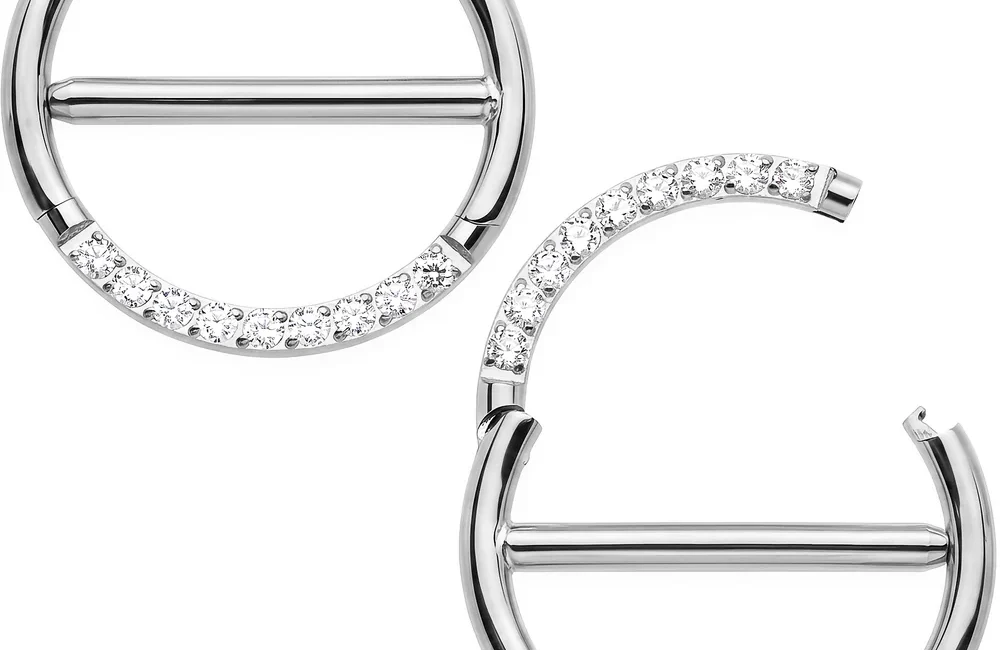
Decorative frames, often circular or teardrop-shaped, that sit around the piercing and connect through the existing barbell or ring. Shields are exclusively a healed-piercing accessory; they add dramatic visual impact but should never be worn on a fresh piercing since they add weight and surface area that can slow healing.
Clickers and Segment Rings
Hinged rings that snap or “click” open and shut, making insertion and removal far easier than a traditional CBR without needing to bend the metal. These have become one of the most popular healed-jewellery styles because they combine the ring look with barbell-level ease of use.
Chains and Dangle Barbells
A single barbell or connected pair with a hanging chain, charm, or gem drop. These are decorative, healed-piercing-only options; the extra movement and weight are not suitable for a fresh piercing and can cause tearing if worn too early.
Materials: What to Actually Look For
Material quality matters more for nipple jewellery than almost any other piercing, since nipple tissue heals slowly and reacts poorly to anything less than surgical-grade metal.
- Implant-grade titanium (ASTM F136): The gold standard for both initial and long-term wear. It’s biocompatible, nickel-free, lightweight, and the least likely material to trigger a reaction.
- 14k or 18k solid gold: A safe, hypoallergenic option once a piercing is healed. Avoid gold-plated or gold-filled jewellery for anything other than short-term, healed wear, since the plating can wear away and expose base metal underneath.
- Niobium: Similar biocompatibility to titanium and a good alternative if you want color options, since niobium can be anodized into different shades.
- Surgical steel (316L): Widely sold and less expensive, but it does contain trace nickel, which makes it a less reliable choice for anyone with metal sensitivities. Many professional piercers now recommend titanium over steel specifically for nipple piercings, given how much contact and irritation this piercing site tends to see.
Avoid low-cost “body-safe” jewellery sold without a material certification; if a listing doesn’t specify implant-grade titanium, ASTM F136, or solid karat gold, treat the “hypoallergenic” label with skepticism.
Choosing Jewellery by Healing Stage
Weeks 0–6 (fresh piercing): Stick to the barbell your piercer used, in implant-grade titanium, at the length they fitted you with. This isn’t the time to experiment with rings or shields; the goal is to let the piercing channel form without extra stress.
Months 2–4 (mid-healing): Once swelling has visibly gone down, a downsize to a shorter barbell is usually appropriate. This is something to do with your piercer rather than at home, since the channel is still fragile.
6+ months (fully healed, varies by person): This is when rings, clickers, shields, and dangle styles become realistic options. Full healing for nipple piercings commonly takes anywhere from six months to a year, sometimes longer, so patience matters more here than with most other piercings.
Sizing and Fit Tips
- Never guess your gauge from a ruler at home if you’re unsure; ask your piercer or use a proper gauge tool, since a size that’s slightly off can be uncomfortable or fall out.
- When buying decorative jewellery online, check both gauge and bar length, not just the gauge. A correctly sized barbell that’s the wrong length will still sit incorrectly.
- If you’re switching from a barbell to a ring for the first time, err on the side of a slightly larger internal diameter rather than a snug fit, to reduce pressure on the piercing.
- Keep at least one spare barbell in your correct size and material on hand. If jewellery needs to come out unexpectedly (for an MRI, a medical procedure, or a piercing emergency), having a backup prevents the hole from starting to close.
Aftercare Basics That Affect Jewellery Choice
Jewellery and aftercare aren’t separate topics; the wrong jewellery can undo good aftercare, and the reverse is also true.
- Clean the piercing with a saline solution rather than alcohol or peroxide, which can dry out and irritate the tissue.
- Avoid rotating or twisting jewellery “to clean underneath it”; this is an outdated practice that actually reintroduces bacteria and slows healing.
- Watch for signs of a genuine nickel allergy (persistent redness, itching, or a rash specifically around the jewellery) versus normal healing irritation, and switch to titanium if a reaction develops.
- Avoid swimming in pools, hot tubs, or open water during the first several weeks, regardless of which jewellery you’re wearing.
Common Mistakes to Avoid
- Switching jewellery too early. Even if swelling looks resolved, the internal tissue is often still healing well after the surface appears normal.
- Buying based on gauge alone. Length, material, and closure type all affect comfort and safety just as much as gauge.
- Choosing steel to save money. The price difference between surgical steel and implant-grade titanium is usually small, and titanium meaningfully reduces the risk of irritation for this particular piercing.
- Wearing shields or dangles before full healing. These styles look appealing early on, but the added weight and movement are a common cause of migration and scarring.
- Ignoring a professional piercer’s downsizing recommendation. Jewellery that’s too long isn’t just a cosmetic issue; it’s the leading mechanical cause of irritation bumps on healed piercings.
Frequently Asked Questions
What is the standard gauge for nipple jewellery?
14 gauge (1.6mm) is the most common size for both initial piercings and long-term wear, though some people are pierced at 12G or 16G depending on anatomy.
Can I wear a ring in a new nipple piercing?
Most piercers start new piercings with a straight barbell rather than a ring, since barbells sit more securely and reduce the risk of snagging during early healing.
What’s the best material for nipple jewellery?
Implant-grade titanium (ASTM F136) is generally considered the safest option for both fresh and healed piercings, followed by niobium and solid 14k–18k gold for healed jewellery.
How long before I can change my nipple jewellery?
Full healing commonly takes six months to a year or longer, and it’s best to have any early jewellery change done or checked by a professional piercer rather than at home.
Why does my nipple piercing keep getting irritated even though it’s healed?
This is often caused by jewellery that’s too long, too heavy, or made from a lower-grade metal like surgical steel. Switching to a properly sized titanium or gold barbell resolves most ongoing irritation.