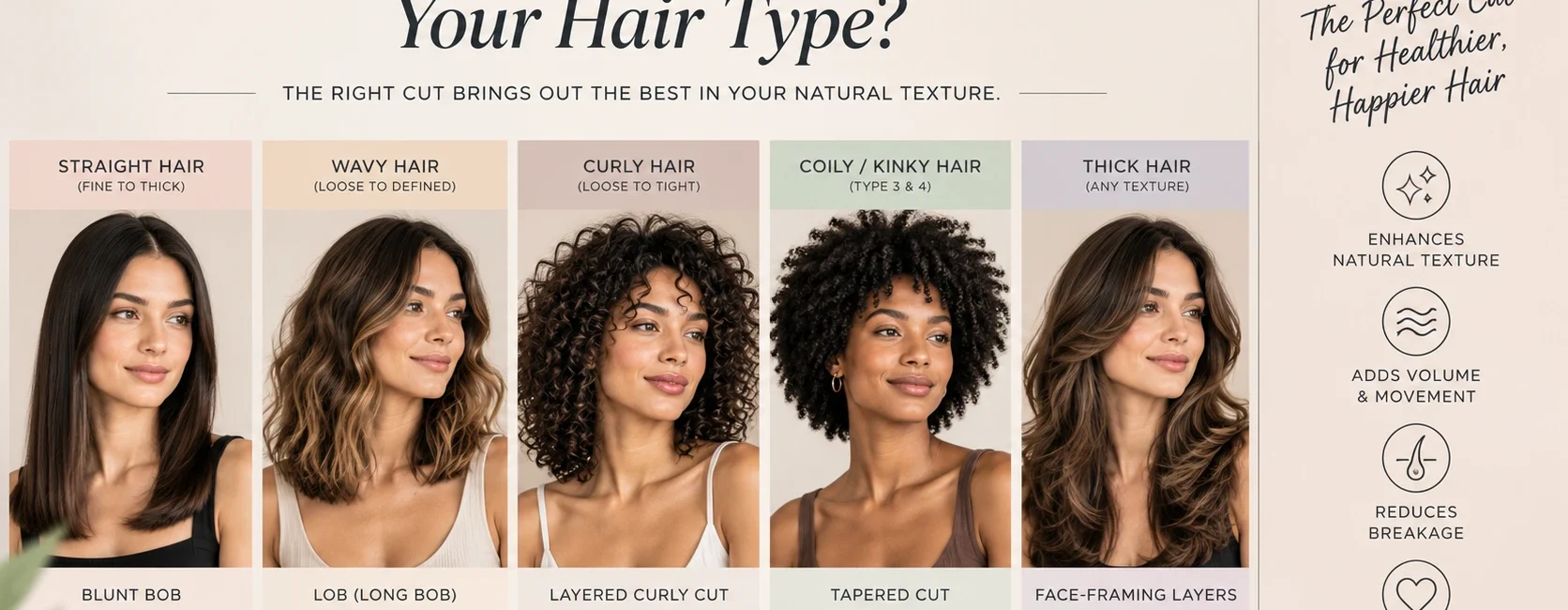
Haircut shopping has a hidden trap: the photo you save is styled, blown out, and photographed at an angle you will never stand at and it is someone else’s hair. Face shape narrows the field, but your hair type makes the final call, because it decides whether the cut you want is one you can actually wear on a normal Tuesday. Before you book, answer one question first: what does your hair actually do? Here is what to ask for and what to avoid for the four most common hair situations.
Quick answer
- Fine hair: a blunt bob or collarbone lob, cut at one length or with only long, minimal layers. Fine hair looks fullest when the ends stay solid.
- Thick hair: a layered cut long layers, a soft U-shape, or a gentle shag to redistribute weight so the shape doesn’t turn triangular.
- Curly hair: a dry cut with a rounded silhouette, and always cut 2–3 inches longer than your goal length to allow for shrinkage.
- Damaged hair: skip dramatic bleach and high-contrast cuts. A soft collarbone lob that removes the worst ends while keeping length lets you cut your losses without cutting everything.
Details for each are below.
Why hair type decides the cut
A haircut is geometry, but every head starts with different physics. Density (how much hair you have), texture (the diameter of each strand), and pattern (straight, wavy, curly) together decide how a cut falls. The same “layered lob” that reads airy and effortless on medium-thick waves can look stringy on fine, straight hair not because the cut is bad, but because the hair underneath it behaves differently. This is why two people can get the same haircut and look like they went to different salons.
The useful move is to choose the cut for your hair’s behavior, then adjust it for your face. Here is how that works for each type.
Fine hair: protect the ends
Fine hair has less total mass, so its enemy is anything that removes more of it. That is why the cuts that photograph best on fine hair tend to be the simplest: a classic bob, a collarbone lob, or a shoulder-length cut held at one length or with long, subtle layers. The solid ends give the eye something to land on, and the shape reads fuller than it is.
What to avoid: heavily layered cuts, deep texturizing, and aggressive use of thinning shears. All three look helpful in the chair and unhelpful three weeks later, when the ends go wispy exactly where you wanted fullness. If your stylist reaches for a razor or a texturizing blade, it is fair to ask what it is doing for your density.
One tip: ask for a “blunt line with invisible layers” interior layers that add movement without touching the outline. Fine hair responds beautifully to that combination.
Thick hair: redistribute, don’t remove
Thick hair has the opposite problem: too much mass in the wrong places. A one-length cut on thick hair can build into a triangle, with all the weight landing at the ends. The fix is layering but layering that moves weight around rather than simply removing it.
What works: long layers, a soft U-shape around the shoulders, face-framing pieces that start below the chin, and a modern shag for anyone who wants movement. Ask your stylist to “take weight out of the interior, not the outline” that phrase does a lot of work. The perimeter stays healthy-looking; the interior sheds the bulk that makes styling a wrestling match.
What to avoid: heavy, short layering that removes chunks of thickness at once, and blunt cuts with no interior movement if your hair is very thick. Both are hard to undo.
One tip: thick hair can handle length and volume at the same time. Going shorter is not the only way to feel lighter.
Curly hair: cut it dry, think in springs
Curly hair should be cut dry, curl by curl, so the stylist sees the actual shape each spring takes. A wet, precise line means nothing once the hair dries and pulls up which is why the shampoo-and-cut routine that works for straight hair betrays curls.
What works: a rounded silhouette that follows the curl pattern, layers that sit within the curl clumps rather than slicing across them, and a length goal that accounts for shrinkage cut 2–3 inches longer than the final look you want. For most curl types, a shoulder-length or collarbone shape with face-framing curls is the sweet spot: long enough to stretch, short enough to shape.
What to avoid: cutting to an exact wet line, blunt horizontal layers that interrupt the curl, and any amount of thinning that separates the clumps.
One tip: bring a photo of your hair “halfway through a wash day” the shape you live with between washes is the shape the cut has to serve.
Damaged hair: recovery first, style second
When hair is over-processed from bleach, repeated colour, or heat damage the right cut is less about self-expression and more about strategy. Split ends travel upward, so removing them is not vanity, it is maintenance.
What works: a soft collarbone or shoulder lob with long layers, trimmed in stages over two or three appointments. You keep most of your length while the worst damage cycles out. Air-drying friendly shapes (light waves, soft texture) also reduce the heat you need day to day.
What to avoid: double-processing (fresh bleach on already lightened hair), high-contrast cuts that draw the eye to thinning ends, and trying to “fix” damage with a single dramatic chop. Drama does not remove damage faster; trimming does.
One tip: ask your stylist for a plan, not a haircut “what does this look like in six weeks, and what do we trim next time?”
The last check: see it before you book
Even with a plan in hand, there is one step most people skip: they decide from imagination. A stylist works far better from a picture than from a description, and you make a calmer decision when you have seen the shape before it happens. A quick way to pressure-test your choice is to preview it on your own photo first. WigTryAI is a free browser tool that lets you upload a photo and try the cut you are considering a blunt bob, a layered lob, a longer curly shape and see how it sits with your face and your density. It takes about a minute, needs no app, and gives you something concrete to bring to the appointment.
For the most honest preview: use daylight, face the camera straight on, and keep your hair dry and unstyled. Then save your two favourite versions and show them to your stylist the conversation changes completely when you are pointing at your own head instead of a stranger’s.
The short version
Match the cut to your hair type first, then to your face: solid ends for fine hair, redistributed weight for thick hair, dry cutting and shrinkage math for curly hair, and gradual trimming for damaged hair. Whichever group you are in, see the shape on your own photo before you commit. That is how a haircut stops being a gamble and starts being a plan.