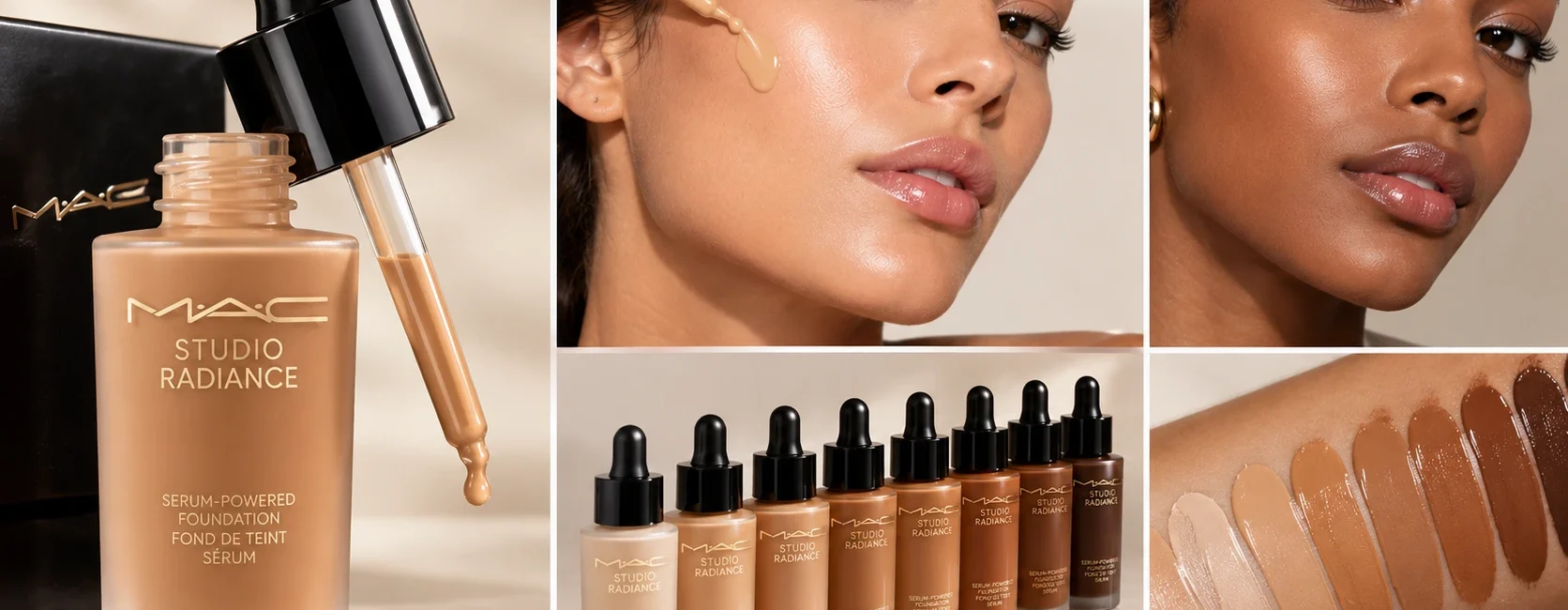
MAC built its name on full-coverage, matte makeup. Studio Radiance Serum-Powered Foundation is the opposite: a light, dewy, skincare-heavy base that aims to make your skin look like skin, only better. It has one of the widest shade ranges in the serum-foundation category and a big claim to match, 12-hour wear and 24-hour hydration. But how much of that holds up in real life, and who is it really for?
Quick Verdict About MAC Studio Radiance Serum-Powered Foundation
| Product | MAC Studio Radiance Serum-Powered Foundation |
| Price | $46 on MAC’s US site |
| Size | 1 fl oz / 30 ml |
| Coverage | Medium and buildable per MAC; reviewers often call it light to medium |
| Finish | Radiant, natural glow |
| Shades | 56 (MAC’s FAQ mentions 59, so check the shade selector) |
| SPF | None listed |
| Rating | 4.5 out of 5 from 825 reviews on MAC’s site |
| Best for | Normal, dry or mature skin that wants a comfortable, luminous base |
| Skip if | You want a matte finish, full coverage or a base that lasts a full night out |
Short answer: It’s a lovely everyday base with a very wide shade range. Expect a glowy, skin-like finish and a few hours of freshness, not all-night matte wear.
What Is MAC Studio Radiance Serum-Powered Foundation?
Studio Radiance Serum-Powered Foundation is a fluid foundation that blends pigment with a large dose of skincare. MAC says the formula contains 33 skincare ingredients and a 10% hyaluronic acid solution, along with olive and jojoba oils, vitamin E, and sunflower seed, cucumber and tremella extracts. Reviews have also repeated MAC’s claim that the formula is roughly 80% skincare and 20% foundation, though MAC’s page doesn’t explain exactly what that percentage measures.
It sits in the same category covered in our guide to serum foundation, where lightweight bases blur the line between skincare and makeup. If you’re new to the category, that guide explains how serum foundations differ from skin tints and classic foundations.
MAC’s Claims vs. What Reviewers Say
This is where many pages simply repeat the brand copy. Here’s a side-by-side.
| Topic | MAC says | Reviewers report |
|---|---|---|
| Coverage | Medium and buildable | Light to medium; evens tone but won’t hide major concerns |
| Finish | Natural, radiant | Dewy and luminous; not matte. Powder tones it down |
| Wear | 12 hours (clinical test of 20 people after one use) | One reviewer needed a powder touch-up after about 6 hours |
| Hydration | 24 hours (clinical test of 23 people after one use) | Reviewers describe comfortable, moisturized skin, even in cold weather |
| Transfer | Water-, sweat- and transfer-resistant | Can look patchy during heavy activity, per one reviewer |
| Skin type | For all skin types (FAQ: normal to dry) | Loved by dry, textured and mature skin; opinions on oily skin vary |
| Shades | 56 | Wide range, but some swatches look different on the face than on the arm |
The takeaway is that the clinical numbers describe results under test conditions, while real-world wear depends on your skin, prep and weather.
Coverage and Finish: What to Expect
Coverage. Think of it as a polished skin-evener. It smooths and blurs, and you can build thin layers toward medium. It won’t mask acne, strong redness or deep scarring on its own, so plan to use concealer where needed. If you want a fuller finish for events, a reviewer who normally wears a MAC Studio Fix shade for special occasions said she wanted a lighter option for everyday wear, which is where this one fits.
Finish. It’s a luminous, dewy look with a “your skin but better” glow. If you love a matte base, this isn’t it. If you want a little extra control on the T-zone, set only that area with a light powder.
Wear Time: How Long Does It Last?
MAC claims 12 hours of long wear. One reviewer reported about six hours before her skin broke down and needed a touch-up, and she considered it better for everyday wear than evenings. Customers on a retailer’s product page praised long wear without creasing. That disagreement is typical for dewy bases, so treat 12 hours as a best case.
What helps it last longer:
- Prep well. Moisturize, then let it sink in for a few minutes.
- Use thin layers. Heavy layers slide.
- Press, don’t rub, so the product settles into the skin.
- Set strategically. A light dusting on the T-zone, not the whole face.
- Check the weather. Heat and humidity shorten wear for any dewy formula.
Is It Good for Oily, Dry or Mature Skin?
Dry and mature skin. This is where it shines. The hydrating formula and flexible finish tend to look good on dry or textured skin. MAC lists it for mature and balanced skin in its product details.
Normal and combination skin. A good fit for most days, especially with a light powder on the T-zone.
Oily skin. Opinions are split. Some customers on retailer pages mention extra shine that can emphasize imperfections, while other roundups recommend it for oily skin. Test it before you commit, and consider a mattifying primer in the T-zone.
Sensitive skin. MAC’s product page doesn’t state a sensitive-skin claim, so patch-test, and ask a dermatologist if you have a skin condition.
Shade Guide: Decoding NC, NW, N and C
MAC offers 56 shades across four prefixes: C, N, NC and NW. One retailer breaks them down as 3 C shades, 4 N shades, 28 NC shades and 21 NW shades. MAC’s page doesn’t define the letters, but each shade has a description, for example NC15 is described as a light beige with golden undertone. Because the codes don’t always map cleanly to undertone, rely on the description, not the letters.
How to Find Your Match
- Pick your depth first. Use MAC’s depth filter, from lightest to rich.
- Choose undertone from the description. Golden, peachy, neutral or rosy.
- Swatch on your jaw, not your wrist. One reviewer noted that a wrist swatch looked different from how the shade wore on her face.
- Wait before you judge. Reports on oxidation differ: one reviewer found her shade ran slightly darker, while another customer found theirs looked lighter after an hour. Give it 15 to 30 minutes.
- Look in daylight.
- Consider an in-store match. One reviewer was unsure about her shade and recommended getting matched in a MAC store.
How to Apply It
MAC suggests using a 170S brush, your fingers or a makeup sponge. Here’s a routine that works well with a luminous base:
- Skin first. Cleanse, moisturize and wear sunscreen. This foundation has no SPF listed, so a dependable Neutrogena sunscreen belongs underneath.
- Hydrate if you’re dry. A lightweight lotion, like the one in this Shiseido hydrating lotion review, helps the base glide.
- Use a small amount. One pump, or less, is usually enough for the whole face.
- Start in the center. Dot on the forehead, cheeks and chin, then blend outward.
- Build thin layers. Add a second layer only where you need it.
- Conceal and set. Add concealer after foundation, then a light powder where you get shiny.
- Optional Serumizer. MAC suggests its Serumizer beforehand, but one reviewer felt it wasn’t necessary because the foundation already has serum.
Ingredients and Packaging
- Key ingredients: hyaluronic acid solution, sodium hyaluronate, olive and jojoba oils, vitamin E, and plant extracts.
- Claims: MAC mentions protection from pollution and blue light via vitamin E.
- No SPF: wear sunscreen separately.
- Packaging: a recyclable glass bottle with a pump and a cap made with 30% post-consumer recycled content.
- Vegan or cruelty-free: MAC’s page doesn’t list a claim, so check the brand’s current policy if that matters to you.
How It Compares to Other Lightweight Foundations
If you’re weighing similar options, this review of the Dior Backstage face and body foundation covers another light, skin-like base and where it falls short on dry skin and coverage. The main difference is that MAC’s formula leans radiant and skincare-focused with a wide shade range, while Dior’s finish is described as more natural and varies by reviewer.
Pros and Cons
Pros
- Very wide shade range, with 56 shades across depths and undertones
- Light, comfortable feel with a skincare-like texture
- Radiant finish that looks like skin
- Buildable coverage
- Good for dry, textured and mature skin
- Recyclable glass packaging
Cons
- Not matte, and can look shiny on oily skin
- Light-to-medium coverage doesn’t hide strong concerns
- Wear time often shorter than the 12-hour claim
- Some shades may oxidize or look different on the face than on the wrist
- No SPF
- Premium price for a base that suits everyday wear
Common Mistakes
- Expecting full coverage. Use concealer where you want more.
- Skipping sunscreen. There’s no SPF listed.
- Picking shade from the wrist. Test on the jaw.
- Using too much. A thin layer looks fresher.
- Judging the shade instantly. Wait for it to settle.
- Powdering the whole face. It cancels the glow. Set only where needed.
Frequently Asked Questions
How much is MAC Studio Radiance Serum-Powered Foundation?
$46 for 1 fl oz (30 ml) on MAC’s US site. Retailer prices may differ.
Is it full coverage?
No. MAC describes it as medium and buildable, and many reviewers find it light to medium.
How many shades are there?
56 per MAC’s product description, though its FAQ mentions 59. Check the shade selector for the current number.
Does it have SPF?
No SPF is listed, so wear sunscreen separately.
Is it good for oily skin?
It’s a dewy formula, so results vary. Test it, and use powder on shiny areas.
Does it oxidize?
Reports differ. One reviewer found it ran slightly darker, while another found a shade looked lighter after an hour. Wait before judging your match.
Is it good for mature skin?
MAC lists it for mature and balanced skin, and its flexible, hydrating finish is a strength.
How do I apply it?
Use a brush, fingers or a sponge, starting at the center of the face and building in thin layers.
Is it vegan or cruelty-free?
MAC’s product page doesn’t list either claim, so check the brand’s current policy.
The Bottom Line
MAC Studio Radiance Serum-Powered Foundation is a comfortable, glowing, skin-like base with a standout shade range, best for normal, dry or mature skin and everyday wear. It won’t deliver matte, full-coverage or all-night staying power, so set your expectations accordingly. Prep your skin, match your shade carefully in daylight, and use thin layers, and it’s an easy way to look fresh without feeling like you’re wearing makeup.