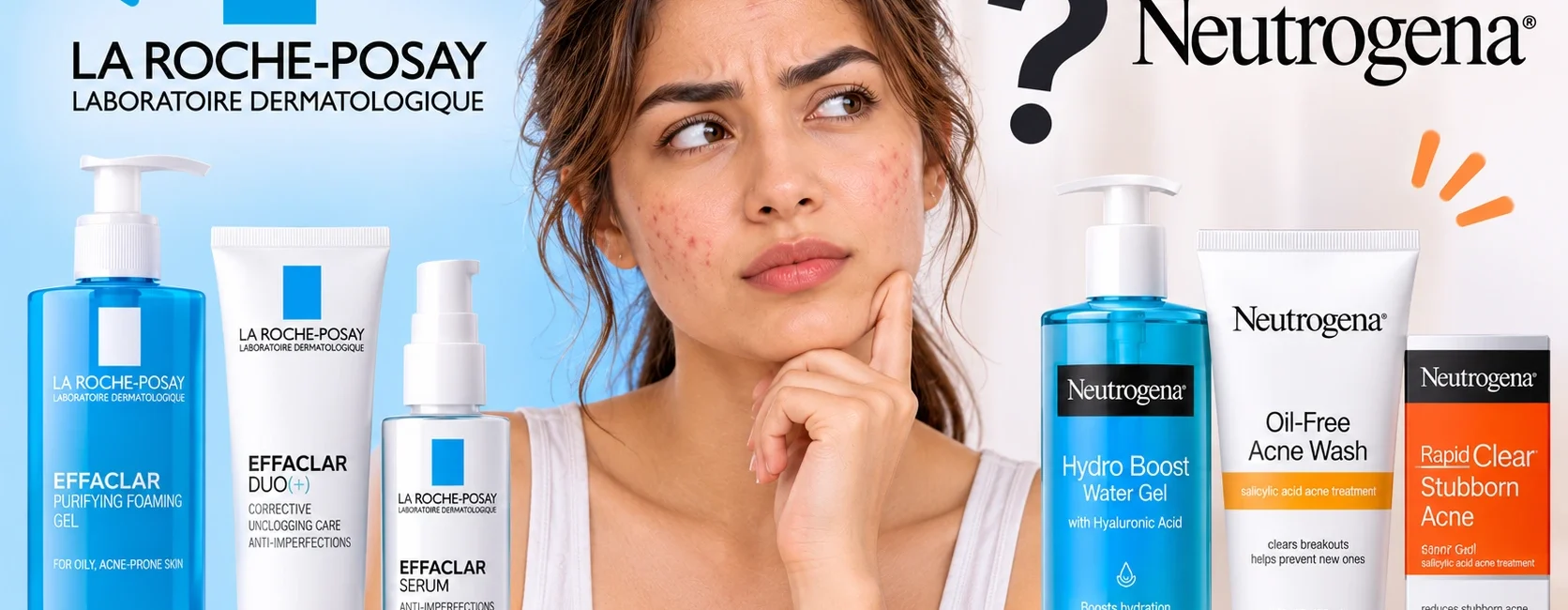
If you typed “I am a college student. Are La Roche-Posay products better for acne-prone skin than Neutrogena?” into Google, the honest answer is sometimes, and mostly not for the reason the marketing suggests.
The logo on the bottle matters far less than the active ingredient inside and its strength. Both brands sell the same core acne fighters, and only one sells a retinoid. Here is where each shelf pays off when your budget is a campus meal plan.
Same Ingredients, Different Price Tags
Strip away the packaging and both brands lean on a short list of acne actives. So do dermatologists. The American Academy of Dermatology’s acne guideline, summarized in American Family Physician in November 2025, calls benzoyl peroxide and topical retinoids effective treatment and describes retinoids as cornerstone therapy.
Salicylic acid gets a weaker nod. The guideline gives it only a conditional recommendation because evidence of benefit is limited. That matters because salicylic acid is the active in the cleansers both brands push hardest.
In other words, the step that sells the most bottles is the step with the thinnest evidence. If you want to see how other popular skincare ingredients rank on research versus hype, this breakdown of which ingredients have real evidence behind them is a useful companion.
Head-to-Head, Job by Job
Acne routines break into three jobs: cleaning, drying out active breakouts, and preventing new ones. The table below matches each brand’s closest product for each job, using prices I could verify.
| Job | La Roche-Posay | Neutrogena |
|---|---|---|
| Cleanser | Effaclar Medicated Gel Cleanser: 2% salicylic acid, 6.76 fl oz, $14.23 at Walmart | Oil-Free Acne Wash: 2% salicylic acid, 9.1 fl oz, about $9.99 |
| Benzoyl peroxide | Effaclar Duo: 5.5% micronized benzoyl peroxide plus LHA, 1.35 fl oz, marketed as fragrance-free | Rapid Clear Stubborn Acne Spot Gel: 10% benzoyl peroxide, 1 oz, $9.68 at Walmart |
| Retinoid | Effaclar Adapalene Gel 0.1%: 1.6 fl oz, about $36 | No adapalene gel found |
| Catch | Duo was tied to a 2025 benzene recall | Cleanser lists fragrance and two dyes; the 10% gel is the harshest option |
Prices shift by store and sale, so treat them as snapshots rather than fixed numbers.
Cleansers: A Wash, Literally
Both cleansers use 2% salicylic acid, so the active is identical. La Roche-Posay costs about $2.11 per fluid ounce at Walmart and Neutrogena works out to about $1.10, which is roughly half.
An ingredient database lists Neutrogena’s wash with fragrance and the dyes Yellow 5 and Red 40, and rates its irritation risk as medium. Shoppers rate both well: 4.6 stars from about 1,450 Walmart ratings for La Roche-Posay and 4.3 from around 35,000 Amazon ratings for Neutrogena.
If your skin tolerates fragrance, Neutrogena’s cleanser saves money for no clear loss in results. If you sting easily, La Roche-Posay’s gentler pitch is reasonable, though nothing I found proves it works better.
Benzoyl Peroxide: Strength Over Brand
This is the category where the brands truly differ, and the difference is concentration. Neutrogena’s spot gel packs 10% benzoyl peroxide and its label tells you to start with one application a day, while La Roche-Posay’s Duo uses 5.5% in a micronized form with an exfoliating acid.
The AAD guideline notes that benzoyl peroxide can cause burning, stinging, dryness, peeling and fabric bleaching, and that lower concentrations may be better tolerated. On Walmart, dryness is one of the most frequent topics in the 10% gel’s reviews.
One database’s review tags show Duo labeled “irritating” more than anything else, though that rests on a small sample of 22 ratings. Treat that as a nudge to patch-test either product, not a verdict.
Retinoids: The Only Real Brand Gap
La Roche-Posay is the only one of the two selling adapalene, a retinoid the guideline places alongside tretinoin as similarly effective. It is the same 0.1% strength sold under the Differin name, and one ingredient database puts store-brand generics at roughly $10 to $15, against about $36 for the La Roche-Posay tube.
That makes the La Roche-Posay version a brand premium, not a stronger medicine. Adapalene can be used with benzoyl peroxide, according to the guideline, but it raises sun sensitivity and is not for use during pregnancy. The same guideline says to consider daily sunscreen with a retinoid, and a guide to picking an everyday sunscreen that suits breakout-prone skin can help you choose one.
So Which Shelf Wins?
Back to the question that brought you here: are La Roche-Posay products better for acne-prone skin than Neutrogena when you are paying with a student budget? Job by job, the answer splits.
For cleansers, there is no meaningful winner, so buy the cheaper one your skin tolerates. For benzoyl peroxide, the winner is whichever strength you can use consistently without wrecking your barrier. For a retinoid, buy adapalene, and compare the generic against the brand before you pay for the logo.
The Recall Your Roommate Will Mention
In March 2025, L’Oréal announced a voluntary recall of La Roche-Posay’s Effaclar Duo over benzene concerns. Reports differ on the scope: one trade outlet described all lots, while another described a specific lot that had already expired.
The issue is bigger than one brand. The FDA tested 95 benzoyl peroxide products and found six with elevated benzene, and an independent lab reported benzene in 34 percent of 111 products tested. The FDA said the cancer risk from these products is very low, and dermatologist Joshua Zeichner, as quoted by MedShadow, advised against panic over benzoyl peroxide.
Neutrogena was not named in the coverage I read, but its absence is not a clean bill of health for every tube on a shelf. Heat appears to speed benzoyl peroxide breakdown, so store these products cool, check lot numbers against recall notices, and toss anything that looks or smells different.
What a Dorm Does to Your Routine
Dorm life adds problems that product comparisons ignore. A windowsill, a hot car or a gym bag in summer is exactly the wrong place for a benzoyl peroxide tube. A caddy in a closet is better.
Benzoyl peroxide also bleaches fabric, so use white towels and pillowcases, and let it dry before you lie down. If you start adapalene, expect dryness and purging in roughly weeks two through six, according to one ingredient database, so begin during a calm stretch rather than finals week.
A Routine Under $40
A workable student stack uses Neutrogena’s cleanser at about $10, a generic adapalene at $10 to $15, and a fragrance-free moisturizer around $14. That lands between $34 and $39 before sunscreen, which is a required purchase once you use a retinoid.
Swap in La Roche-Posay’s cleanser if fragrance bothers you and you add roughly $4. Use adapalene at night, moisturizer after, and sunscreen every morning. Add a benzoyl peroxide spot treatment only if breakouts persist, and start with one application a day.
When Neither Brand Is the Answer
Drugstore products have limits. If you have painful, deep nodules, scarring, or no improvement after two to three months of consistent use, book an appointment. Your campus health center can often point you toward a dermatologist or a telehealth visit.
The AAD guideline strongly recommends oral isotretinoin for severe, scarring or treatment-resistant acne. No cleanser, from either brand, replaces that conversation.
The Bottom Line
Are La Roche-Posay products better for acne-prone skin than Neutrogena? Not across the board. The cleansers are equal in their active ingredient, the benzoyl peroxide products differ mainly in strength, and La Roche-Posay’s only exclusive is an adapalene gel you can buy cheaper under another name.
Pick by active ingredient, patch-test anything new, store your tubes cool, and spend the money you save on sunscreen.
Frequently Asked Questions
Which brand is gentler for sensitive acne-prone skin?
La Roche-Posay markets the Duo as suitable for sensitive skin and fragrance-free, while Neutrogena’s cleanser lists fragrance. Neither claim replaces a patch test, since reviewers report irritation with both.
Can I mix products from both brands?
Yes. The brand matters less than the ingredients, so avoid stacking several strong exfoliants or benzoyl peroxide products at once.
Is adapalene or benzoyl peroxide better?
The AAD guideline calls both effective and says adapalene can be combined with benzoyl peroxide. Many people start with one and add the other if breakouts persist.
How long until I see results?
Dermatologists commonly suggest giving a routine eight to twelve weeks. Expect adapalene to cause dryness and purging in the first several weeks.
Is benzoyl peroxide safe after the recalls?
The FDA said the cancer risk from the affected products is very low. Store tubes cool, check lot numbers against recall lists, and ask a dermatologist if you are worried.
Do I need a prescription?
No. Benzoyl peroxide and 0.1% adapalene are sold over the counter in the US.
Do I need sunscreen with these products?
Yes, especially with adapalene. The AAD guideline says to consider daily sunscreen with a retinoid, and one ingredient database recommends SPF 30 or higher.
Is the salicylic acid cleanser worth it?
It is a low-risk, low-cost step, but the guideline’s recommendation is only conditional because the evidence is limited. Put more of your budget into benzoyl peroxide or adapalene.