
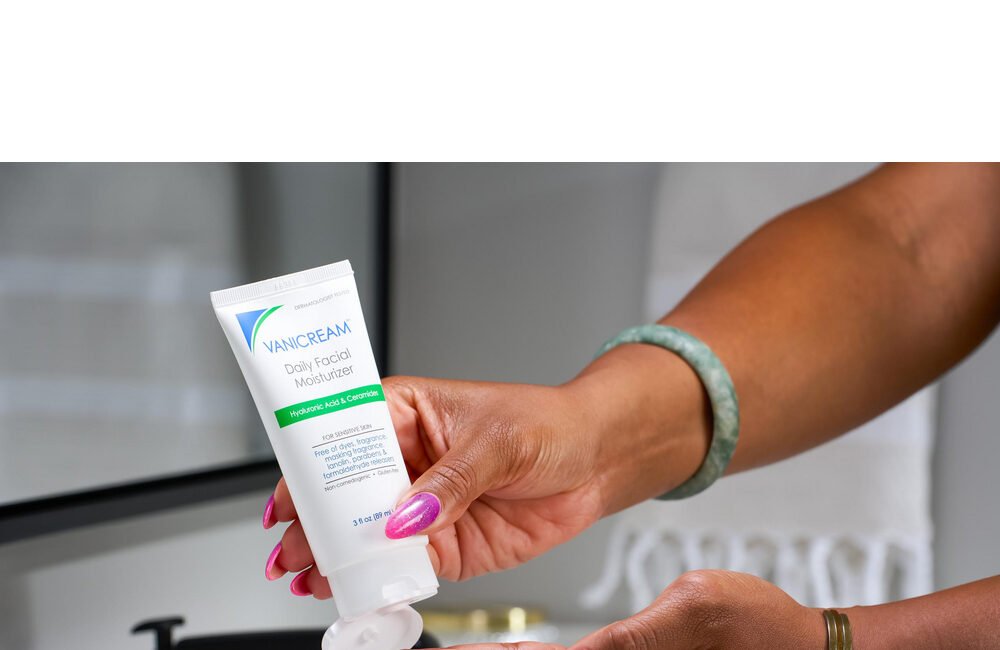
Vanicream daily facial moisturizer is the plain white tube dermatologists often name when a patient’s skin reacts to everything else. It is also the product shoppers most often mistake for a sunscreen, which it is not.
Between that mix-up, a split verdict on oily skin, and a few ingredients worth knowing about, there is more to this $14 lotion than its minimalist label suggests. Here is the full picture before you buy.
Two Vanicream Face Lotions, One Big Difference
The brand sells two similar-looking face moisturizers, and search results blur them together. The one covered here has no sunscreen at all. Its sibling is a mineral SPF 30 lotion with zinc oxide.
That difference decides your morning routine. If you buy the non-SPF tube and skip sunscreen, you have moisturized your face and left it unprotected. The table below keeps the two straight.
| Daily Facial Moisturizer | Facial Moisturizer with SPF 30 | |
|---|---|---|
| Sun protection | None | Zinc oxide, broad spectrum SPF 30 |
| Size | 3 fl oz | 2.5 oz |
| Typical price | Roughly $14 to $18 depending on retailer | $13.97 at Walmart |
| Hero ingredients | Five ceramides, hyaluronic acid, squalane | Ceramides, non-nano zinc oxide |
| Finish | Satin to semi-matte | Mixed reports of a brief white cast |
| Best time to use | Morning or night | Daytime |
| Needs separate sunscreen | Yes | No |
The table is the only comparison you need to avoid buying the wrong tube. Everything below applies to the non-SPF lotion.
What the Ingredient List Really Says
Vanicream lists 19 ingredients, which is short by modern skincare standards. It also carries the National Eczema Association Seal of Acceptance, and the brand says it is pH balanced, non-comedogenic and free of botanical extracts and essential oils.
The Barrier Crew
Water leads, followed by squalane and glycerin. Glycerin pulls water into the skin, and squalane is a lightweight emollient that softens without a heavy feel. Hyaluronic acid adds more water-binding power.
The standout is the ceramide set: EOP, NG, NP, AS and AP. Ceramides are the fats that help hold the skin barrier together, so a lotion with five of them is a sensible pick for dry, tight or irritated skin. Phytosterols stand in for cholesterol, which completes the barrier-lipid trio, and carnosine adds a mild antioxidant.
The Fine Print Most Reviews Skip
Two details deserve a second look. The first is stearyl alcohol, a fatty alcohol that thickens the lotion. It is not the drying kind of alcohol, but one long-term reviewer flags it as a possible irritant for some people.
The second is the preservative system. Instead of parabens, the formula leans on pentylene glycol, caprylyl glycol and 1,2-hexanediol. If glycols have ever bothered you, patch-test before committing.
That reviewer also notes that several ingredients, including the ceramides, phytosterols and hydrogenated lecithin, can be soy-derived, and phytosterols can come from sunflower seeds. Allergies to soy or to daisy-family plants are worth checking against the label.
Curious how these ingredients stack up against what is trending? A closer look at which skincare ingredients are earning their shelf space heading into 2027 puts ceramides and hyaluronic acid in context.
How It Feels on Skin
Reviewers describe a water-based lotion that behaves like a creamy serum. It spreads easily, absorbs quickly and leaves a satin to semi-matte finish rather than a greasy film.
It also layers well. One reviewer reports no pilling under sunscreen or makeup, and the brand itself lists it as suitable to wear under makeup. There is no real scent, only a faint neutral note, which one fragrance-sensitive tester found easy to tolerate.
Oily, Dry or Combination? A Split Verdict
Opinions diverge here, and that is where most guides go vague. Dr. Jenny Liu, quoted in an AOL roundup, calls the texture lightweight and non-sticky and says it suits oily and combination skin especially well. The brand says it works for sensitive, oily, dry and combination skin.
Meanwhile, one ingredient database lists oily skin as both a best match and a skin type to avoid on the same page. Squalane and fatty alcohols make it a lotion rather than an oil-free gel, so very oily skin may feel it by mid-afternoon.
So treat the vanicream daily facial moisturizer as a strong pick for normal, combination, dehydrated and sensitive skin. Very dry skin may want a richer cream on top at night, especially as indoor heating kicks in. Very oily skin should test it for a week and check the T-zone around 3 p.m.
The Six-Month Problem Nobody Mentions
One detail from a long-term review stands out. After about six months, the reviewer’s skin started tingling and stinging, which they traced to stacking this lotion with other hyaluronic acid products.
That is a single account, not a documented pattern, but the lesson is practical. If you already use a hyaluronic acid serum, you are layering the same ingredient twice. Dial back one product if your skin starts to feel prickly after a calm stretch.
Where It Fits in a Routine
The brand places it after a serum and before sunscreen or makeup, and says you can use it twice a day. A nickel-sized amount covers the face and neck.
In the morning, the vanicream daily facial moisturizer still needs a sunscreen over it. A guide to picking a daily sunscreen that sits well on top helps if you are shopping for one. At night, it can sit directly on clean skin, or underneath a richer cream if your skin runs dry.
A tube lasts about five to six weeks with twice-daily face and neck use, according to one ingredient database. That works out to roughly 30 to 50 cents a day, and the listed shelf life is 12 months after opening.
A One-Week Test Before You Commit
Skin takes time to show how it feels about a new product, so a quick test beats a snap judgment. Start with a patch test for three days on the inner forearm or behind the ear, then move to a small area of the jaw.
Once the lotion is on your full face, change nothing else for a week. Keep your cleanser, serum and sunscreen the same, because swapping several products at once makes it impossible to tell which one caused a reaction.
Pay attention to three moments. Notice how your face feels right after application, how it looks under makeup by midday, and how it feels at night. Tightness by evening means you may need a richer layer. Shine by lunchtime means the formula is too much for your oil levels.
If everything stays calm, you have your answer. If you feel stinging, redness or small bumps, stop and go back to your previous routine before blaming the lotion or anything else.
Who Should Skip It
Skin that is actively raw or inflamed is not the moment to introduce a new product, even a gentle one. The long-term reviewer also would not recommend it as a one-and-done moisturizer for very dry skin, or for anyone sensitive to glycols or fatty alcohols.
A basic patch test is worthwhile for anyone with a history of reactions. Apply a small amount to the inner forearm or behind the ear for a few days before using it on your face.
What It Costs and Where to Buy
Prices vary by seller. Walmart lists it at $13.97, a dermatologist-roundup article quoted $14, an ingredient database lists $15.99, and one reviewer paid $16 to $18. Check the seller name on marketplace listings so you are buying a genuine tube.
Customer scores run high. Walmart shows 4.8 stars from 53 ratings, and one ingredient database cites a 4.5 average from about 12,000 Amazon ratings.
The Verdict
For sensitive, combination or dehydrated skin that needs a calm, no-fuss moisturizer, the vanicream daily facial moisturizer earns its reputation. Pair it with a separate sunscreen in the morning, watch your hyaluronic acid layering, and patch-test if you react easily. Very dry or very oily skin may want a different formula.
Frequently Asked Questions
Does it contain sunscreen?
No. This moisturizer has no SPF. Vanicream makes a separate mineral version with SPF 30, and you will need a sunscreen over the non-SPF lotion in the morning.
Can I use it morning and night?
Yes. The brand says it can be used twice daily, and it works as a day or night moisturizer.
Is it fragrance-free?
The ingredient list contains no fragrance, and reviewers describe it as unscented apart from a very faint neutral smell.
Will it clog pores?
The brand labels it non-comedogenic, and a dermatologist quoted by AOL says it will not clog pores. Individual skin can still react, so test it first if you are acne-prone.
Is it safe during pregnancy?
One ingredient database says yes, but confirm with your doctor, since that is a third-party claim.
Is it vegan or cruelty-free?
A third-party ingredient database lists it as neither, and the brand’s product page makes neither claim. Check with the brand if that matters to you.
Does it work under makeup?
Yes. The brand lists it as suitable under makeup, and a reviewer reports no pilling under sunscreen or foundation.
Can I use it with retinol or vitamin C?
It contains no active ingredients that conflict with them, and many people use ceramide lotions to buffer dryness. Introduce new actives gradually and stop if you feel stinging.